Dancing to Design: Larry Walshe on Building a Global Event Design Brand

by David Litwak | 2025-10-07

From the West End stage to the world’s most opulent celebrations, Larry Walshe has always been driven by artistry. After a career-ending injury forced him to leave musical theatre, he discovered the events world and turned a $500 gamble at his dining room table into a global event design studio with locations in London, New York, Lake Como, and Cannes. In this conversation with our CEO, David Litwak, Walshe shares how he built his brand without compromise, why he believes in doing one thing brilliantly instead of three things badly, and how he once transformed a French château’s fountain into a floating dance floor for 300 guests. Let’s dive in.

David Litwak: How did you start your business? Tell me the full history, the most interesting, crazy parts.

Larry Walshe: Well, originally, I actually trained in musical theatre. I was a dancer and performed in the West End. Then I had an accident during a show that meant I couldn’t dance anymore, so I had to figure out what “plan B” was.

I bounced around a bit, tried different things. I always describe it like being Goldilocks: testing different bowls, trying to figure out what fits. Eventually, I ended up working for an event company, actually an event caterer in London. And honestly, I had zero idea there even was an “events industry.” I didn’t know what the scope was, what any of it looked like.

I was supposed to be there for two weeks, just helping out in the office. Several years later, I was still there and starting to feel like I don’t think I’m supposed to be here anymore.

But along the way, I inevitably worked with clients who would say, “Oh, could you do that?” And being somewhat creative, I’d say, “Yeah, okay, no problem, I can design this, I can draw that.”

One particular project sticks out. It was in London, in a venue on the scale of the Natural History Museum, but for just two people. Their brief was: make it intimate. And they gave me three days. Perfect, nothing like last-minute.

So there I was, 11 p.m., sketching at my desk, sending drawings out to vendors, and getting quotes back. The numbers were substantial. And I suddenly realized I was giving away a lot of my ideas. If I could just put A and B together, I could probably do this myself.

So I took a two-week holiday from work. Did a flower course. Came back, handed in my notice, and quit. Sat at my dining room table with $500 in my pocket and thought: This is what I do now. That was 11 years ago.

Since then, we’ve grown the business. We started in London, then expanded to Lake Como, Italy, then New York. And just this year, we opened in Cannes, in the south of France. Four global locations now. And honestly, I’m not adding any more I can’t deal with more rent! But we’ve built a truly global business, one that lets us work robustly across all of these regions.

David Litwak: Just for the benefit of our readers, describe everything that you do. Obviously, you’re a florist, but it sounds like it’s much more than that. What’s the full “Larry Walshe” experience, start to finish?

Larry Walshe: We very much categorize ourselves as event designers. We look after anything that’s visual. It started with flowers originally, but over the last decade, it’s expanded into anything you see when you walk into a celebration or event.

That could be scenic build-outs, paintwork, flooring treatments, technical lighting production, florals, décor, rental items, essentially, any of those visual elements.

We take an artistic overview. I often say we’re like art directors for a celebration. We’ll work closely with other vendors, but our role is to ensure everything is really well curated and considered, so the overall look feels intentional.

And it’s not just about the big picture. It’s also about the details that every single element has been given the same level of attention. You don’t end up with four or five different people’s opinions clashing in the middle of a table. Instead, everything flows as one cohesive vision.

Because what happens otherwise is one person does one thing, another person does something else, and then someone else completely ignores the brief and just pops something down in the middle like a bright blue menu card that clashes with everything.

For us, it’s about having the ability to curate the entire look for the client and act as the caretaker of that vision.
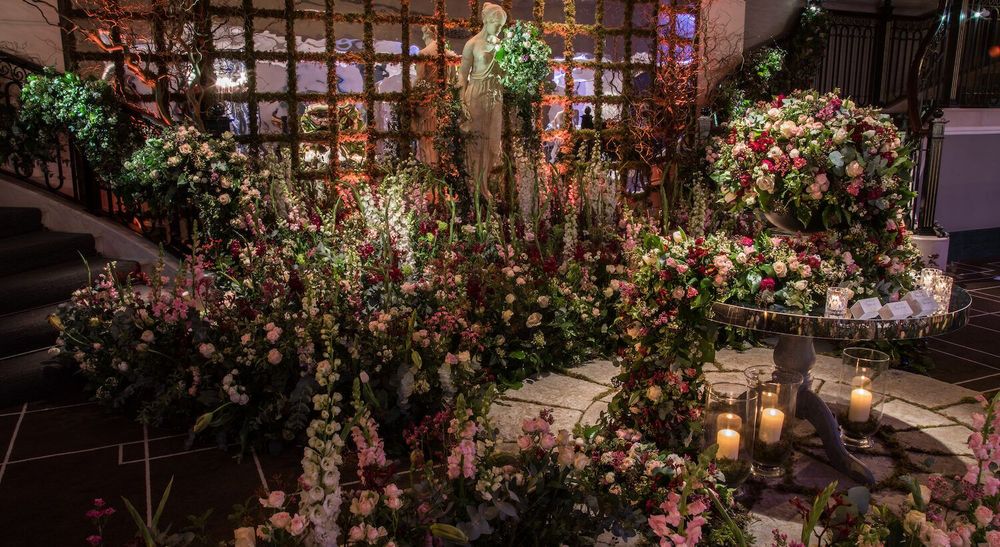
Luxury flowers for the rosewood hotel garden party by larry walshe studios

David Litwak: Very cool. What would you consider to be kind of a “hack”?

What I mean by that is, one thing we think of as a hack for our business, Maxwell, is the fact that we’ve identified a gap in the market. On one side, you have these fully white-box spaces where, sure, you can build a forest inside them if you want, but you also have to bring in everything. On the other side, you’ve got restaurants, where everything is already built out, but you’re locked into their menu and their cocktails, and that’s it. Take it or leave it.

At Maxwell, we think of ourselves as sitting in this Goldilocks zone. On one end, you’ve got the white-box spaces, blank canvases where you can build a forest inside if you want, but you have to bring in absolutely everything. On the other end, you’ve got restaurants, everything is already built out, but you’re locked into their menu, their cocktails, their way of doing things.

We sit right in between. We’ve got a beautiful space that’s already 80–90% of the way there, and then we (or our clients) can build from that. It saves a lot of money on all the extras, and it makes the lift so much easier. That’s what I’d call our little hack, or our secret.

I’m curious, when you were starting your business, was there a central insight like that for you, where you thought, Hey, no one’s doing this?

Larry Walshe: So it’s very, very similar. But going back to your point about the “hack” of where you are, I think that’s the beautiful thing about your property. It’s certainly why I rented it.

When I was planning our official launch party, I thought, in an ideal world, I’d live in a townhouse in Tribeca or Soho. I’d just invite everyone over for drinks. Except the reality is, I don’t live in a multi-story townhouse in any of those neighborhoods. So I thought: I just want somewhere people can walk into and feel like they’ve stepped into my living room.

Your space achieves that. Décor-wise, it’s very much what I’d call an English members club vibe—super eclectic, super cool, with a great mix of patterns, prints, fabrics, and textures. That’s very much my aesthetic anyway.

But I also think it’s not just about saving money by not having to build something from scratch. As a designer, I always encourage working with the environment you already have and enhancing it.

If a venue already has strong design elements, it means we can spend the budget elsewhere and develop a more meaningful response for the event than if we had to start at ground zero.

So for me, the hack is really finding gems like that. Because when a client says, I want members club chic—which right now is nearly every after-party I do, I can say, Absolutely, no problem. And if I already know a space like yours fits that vibe, my job just got easier. It means I can spend my time pushing the design further, creating something more intricate that I might not otherwise have the chance to do.

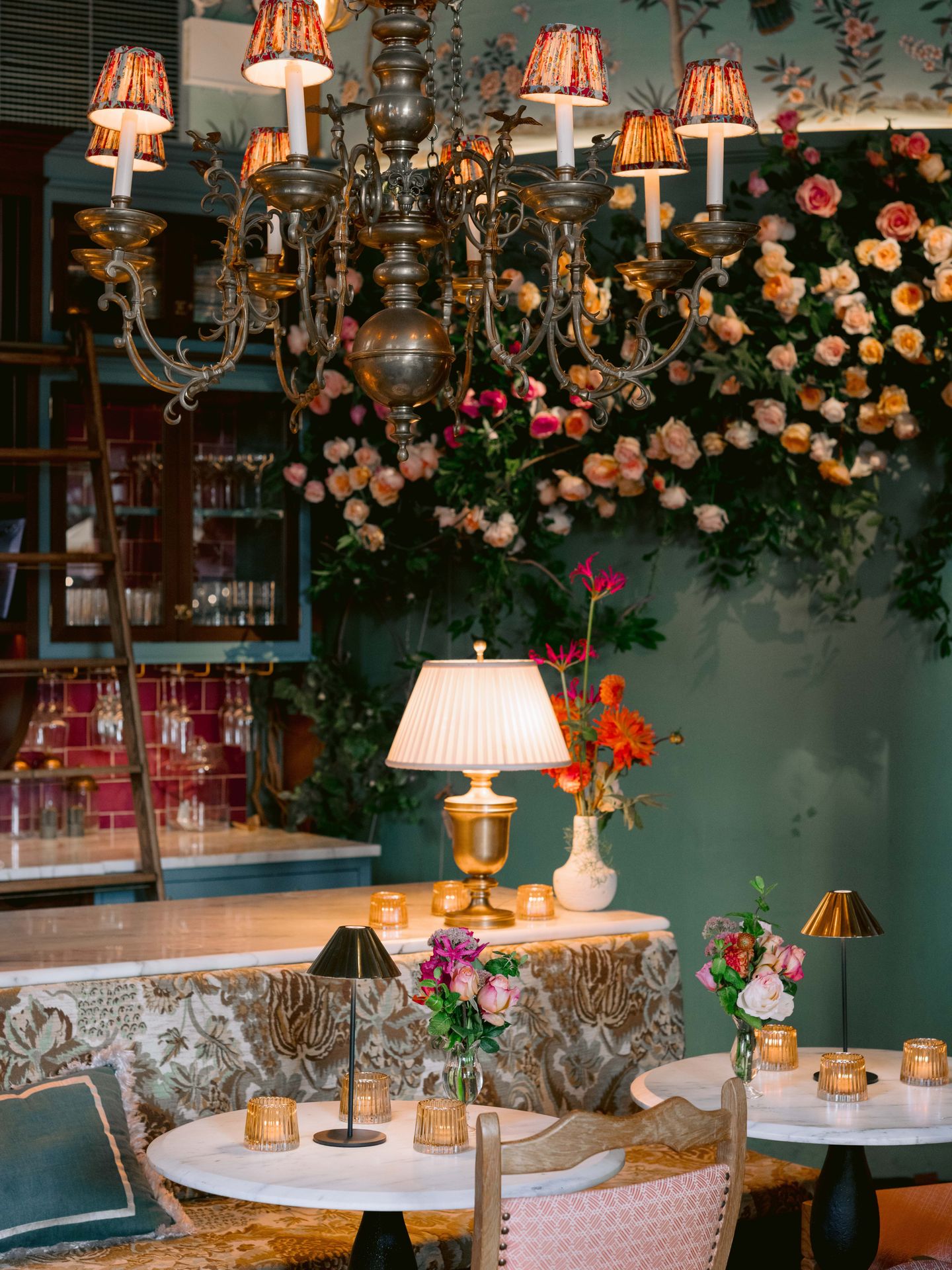
Maxwell studio adorned with florals by Larry Walshe Studios for their launch
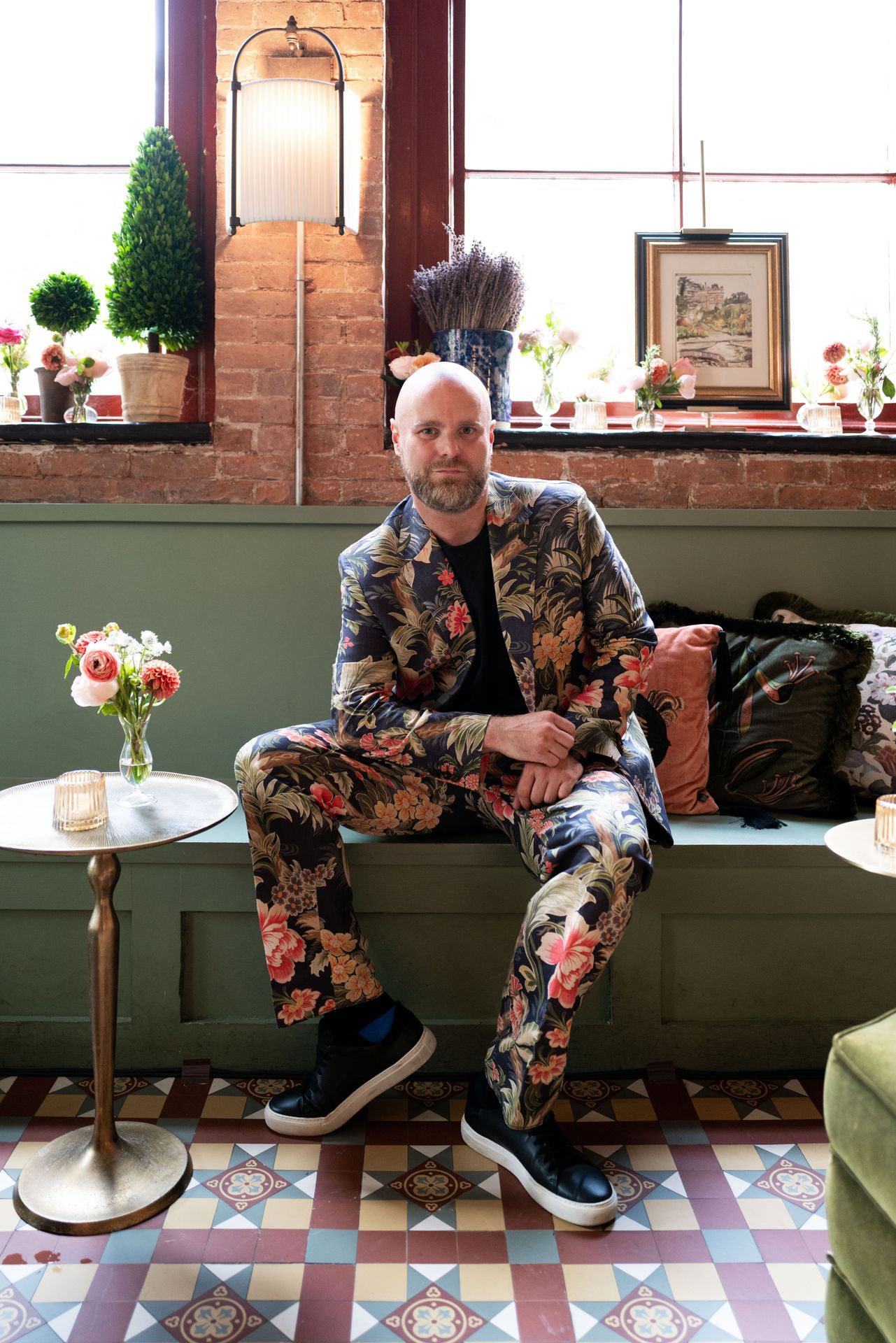
Larry Walshe himself, making a bold statement that matched the artistry of the evening

David Litwak: Yeah, 100%. Funny what you say about leaning in even farther—I’ve noticed the same thing in our design process.

I designed most of our spaces, and I found it was so much easier to get inspired when I could latch onto a single element. The process flowed much more fluidly in our Garden Room, for example, because we became obsessed with this Cox London chandelier in the corner. It’s made up of 100–200 metal pieces, some raw, some gold-plated, beautifully welded together. I just became obsessed with it.

From that point on, everything else in the room flowed more easily, because I knew what I was building around.

By contrast, it took us a lot longer to figure out what we were building our Grand Room around, and I think we failed a little bit during that process. That experience taught me that with new spaces, I always need to identify one or two iconic moments.

And I imagine it’s similar for you, when you find a venue with something you can latch onto, it makes it easier to build a stronger product on top.

Larry Walshe: Totally. And that ties back to how I used to design right at the beginning. I still stand by the idea that it’s better to do one thing well than three things badly.

But of course, when I started, I didn’t have the budgets I get today. I didn’t yet have the experience, the reputation, or the portfolio. So back then, I would always try to find one hero moment in every celebration, one element I hadn’t done before, or something that would creatively stretch me, excite me, or challenge me.

Now, I might have twenty of those moments in a single project—because I can, and because clients trust me to bring them to life. But at the beginning, it was always: pick one.

That way, each event gave me one epic photo: one unforgettable wedding shot, one standout dinner moment, one showstopping detail. And then people would say, “Oh my God, your work is always epic.”

The truth is, I don’t think I’ve necessarily gotten better over the last decade. I was good at the beginning. I just didn’t have anyone trusting me as much as they do now.

So really, it was about cherry-picking that one moment in order to build a portfolio. You start with that single thing, and then you design around it.

Right—and it goes back to that same principle: do one thing well, not three things poorly.

The challenge is that most people don’t always see or understand the value. Take your example of the custom light you were obsessed with. If I turn around and say, “Okay, that’s going to cost $200,000,” someone else might say, “Well, I can buy three lights down the road for $120 each.”

But the person who thinks those are the same thing is sadly mistaken.

What people do see is the authenticity and the intention behind a space. It’s not really about the money. It’s the fact that this piece is handcrafted that a skilled artisan poured time and artistry into it. That has value.

And for the right audience, that craftsmanship becomes magnetic. They’ll be obsessed with it. At that point, price becomes irrelevant because all they’re thinking is, “I want to be in this space.”

David Litwak: Yeah, that’s what we realized. You can either compete on the same playing field as everyone else, or you can position yourself in the top 0.1% of spaces in the world. And from a business standpoint, that’s where you want to be—because at that level, clients have essentially unlimited wallets. They want this, they’re going to get this.

I remember a friend who had a townhouse and was doing events. She told me how thrilled she was to receive $20,000 for a five-day booking, which included all meals and lodging. Meanwhile, we had just closed a $90,000 event for one night.

I almost felt guilty telling her, but the reality is, once you start playing in that part of the market, it’s a completely different calculus for the clients you’re going after.

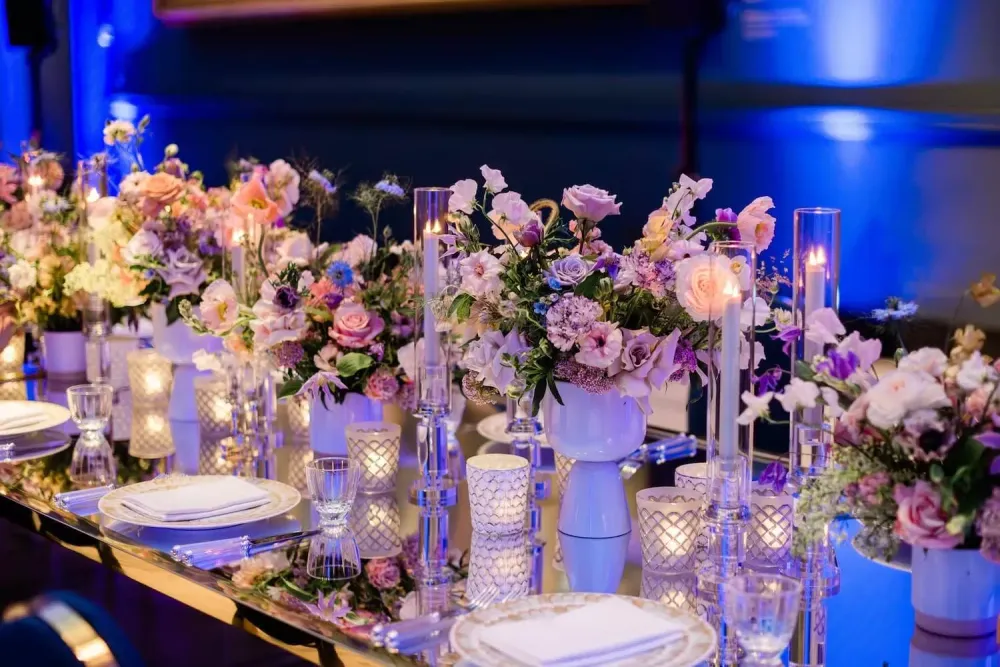
Elegant dinner flowers for an event at the Victoria and Albert Museum by Larry Walshe Studios

Larry Walshe: It is, but then your business mindset is very different when you stop trying to imitate or compete with what already exists. Instead, you say, I’m going to stay in my own lane, focus on quality product, quality service, and let that speak for itself.

That’s been my approach too. I’ve spent 11 years refusing to dilute my product.

In year one, for example, I created this epic tree for a ceremony. It was the only truly great part of that wedding, but it was really good. I still use it in my portfolio today. Now, of course, I’ll get a hundred different photos I could use from a single event because there are so many moments to celebrate.

But the principle has never changed: I won’t dilute my product just to win a piece of business. I won’t create a table centerpiece I don’t believe in, because I don’t want any client, guest, or venue posting a photo of something I’m not proud of.

That consistency is what’s allowed me to build the global presence I have today. I’m the only event designer in the world with a legitimate footprint in multiple countries, which means I can offer clients a global service. A client can walk into my sample room and design studio in Harlem to plan a project happening in Europe, and that convenience is invaluable—especially for clients who are time-poor.

David Litwak: Yeah, well, last fun question here—tell me about the coolest client or project you’ve done, the one that really filled your cup.

Larry Walshe: I did a really nice one in June, actually, in France with a New York couple. They had chosen this absolutely stunning, iconic château. We were walking the grounds, and they stopped in front of this enormous fountain at the end of an Italian garden. They just said, I want to party there.

So I asked, “Okay, in front of it?” They said, “No, no, on it.”

This fountain was huge, the size of a football field. So essentially, they were asking to party on water.

And we did. We built a multi-level structure across the fountain, designed to match the existing architecture. I had artists recreating the stonework so the platforms blended seamlessly with what was already there. What we created was this incredible stage, dance floor, and dining area for 300 people, set right on top of the fountain, in the gardens of a château in France.

It was one of those projects that started as a blank piece of paper with a wild request—and turned into something unforgettable.

David Litwak: This was a real pleasure. Thanks for your time, Larry.

Larry Walshe: Have a great day. Bye, David.

Need help producing your event?

We built Maxwell Studios to provide full service, vertically integrated creative production, built from inside the very walls where our community has been coming alive since 2021.

CREATIVE DIRECTION

CHEF COLLABORATION

AV PRODUCTION

LOGISTICS

Address: 135 Watts, Floor 1, New York, NY, 10013

Walkable TO Westside Highway, One World Trade Center 9/11 Memorial, Duane Park, Battery Park

Nearby Neighborhoods

Tribeca, Financial District, SoHo, West Village, Greenwich Village, Nolita, Hudson Square

HOTELS NEARBY

Foquets, Greenwich Hotel, Arlo Soho, The Roxy, Soho Grand, The Frederick Hotel, Warren St Hotel, The Dominick, Hotel Hugo

LATE NIGHT spots nearby

Paul's Casablanca, Paul's Baby Grand, EAR Inn

Dinner spots nearby

The Odeon, Locanda Verde, Forgione, l'abeille, Wolfgang's Steakhouse, Yves, Mr Chows

Subway lines

Ready to join the family? We can’t wait to host you.

Ready to join the family? We can’t wait to host you.

Join our events list to get first access to availability, ideas from past celebrations, and exclusive Maxwell-hosted experiences.

Maxwell Social | THE RULES ARE DIFFERENT AT HOME