America's Most Intellectual Cities: Where Ideas Still Have a Nightlife

by David Litwak | 2026-08-31

Diplomas end more than classes. For most adults, graduation closes the door on the built-in supply of ideas, debate, and interesting strangers that school provided, and little else fills the gap. Maxwell Social ranked the 50 largest U.S. metros on museums, libraries, graduate degrees, universities, adult education, bookstores, and search interest in things like book clubs and philosophy lectures to find out where intellectual life still thrives after school ends.

We paired that ranking with a survey of 905 adults on where, if anywhere, they still find that kind of community. The results point to a scarcity of rooms built for idea sharing and to a demand for them that cuts across generations and geography alike.

KEY TAKEAWAYS

  • Boston, Hartford, and San Francisco are America's three most intellectual cities, the highest-ranked of the 50 largest U.S. metros for intellectual life outside the classroom.
  • Riverside, Fresno, and Las Vegas are the least intellectually engaged of the 50 largest U.S. metros.
  • Hartford, CT, has a genuine love affair with books, with more library branches per resident than any other major U.S. metro and the strongest overall library showing in the study, landing it at No. 2 overall.
  • Millennials lead the loneliness gap: 49% feel intellectually lonely, and adults say meaningful conversation starts declining just three years after finishing school.
  • 66% of adults would swap a night of drinking for a night built around ideas, and 83% of adults who go to bars say bars feel "intellectually empty."
  • 68% of adults say they crave smarter social environments as they get older, and nearly half (49%) say alcohol plays no role in their social life at all.

BOSTON LEADS AMERICA'S MOST INTELLECTUAL CITIES

To find where intellectual life is most alive, we scored the 50 most populous U.S. metros across seven weighted measures to create an "Intellectual Life Score" on a scale of 0 to 100. These measures included museums, public libraries, graduate degrees, universities, adult education, bookstores, and search interest in intellectual activities.

Boston, Hartford, and San Francisco topped the list as the country's three most intellectual cities, the highest-ranked of the 50 largest U.S. metros for intellectual life beyond school. Southern New England claimed three of the top four spots overall: Boston (80.3), Hartford (72.3), and Providence (66.2), with San Francisco (67.7) breaking up the sweep at No. 3. Riverside, Fresno, and Las Vegas ranked lowest among the 50 metros studied, with Houston and Phoenix rounding out the bottom five.

Raw numbers didn't always translate to achieving the highest rank. The New York metro area had more museums (418), library outlets (730), and universities (242) than any other metro, yet landed 8th once population size was factored in.

Graduate degrees didn't guarantee curiosity either. Providence ranked just 30th of the 50 metros for graduate degrees but was 4th overall. Cleveland ranked 39th for degrees but 15th overall, while Raleigh ran the opposite way, 5th for graduate degrees but only 29th overall.

CITIES AT THE TOP, BY CATEGORY

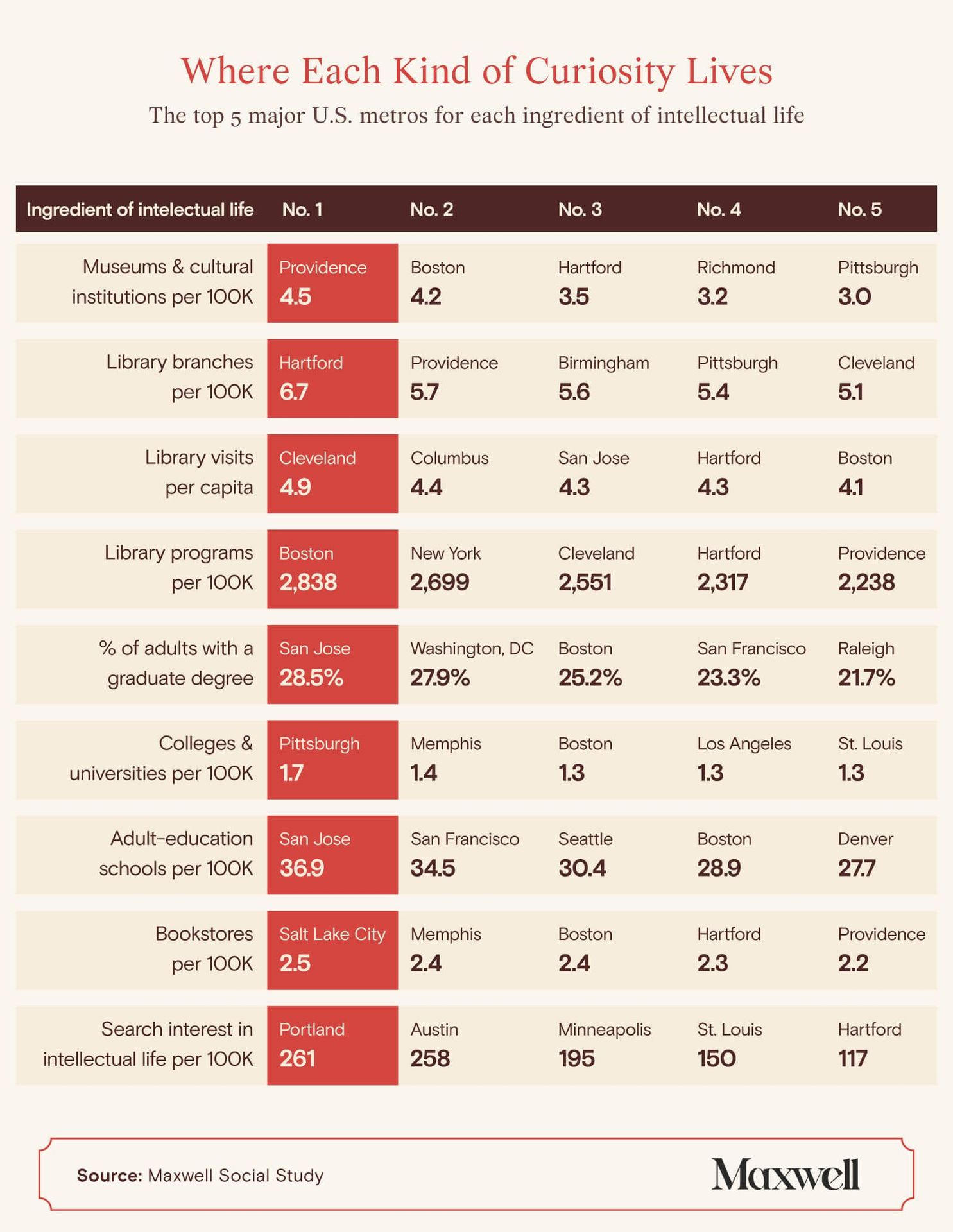
No metro wins everything. Each ingredient of intellectual life has its own capital city.

Infographic ranking the top U.S. metros for intellectual life factors including museums, libraries, graduate degrees, universities, bookstores, and intellectual search interest.

Portland searched for intellectual life, including book clubs, lectures, chess, and trivia, more than any other major U.S. city. With 261 searches per 100,000 residents, this habit helped push it to No. 7 overall. Austin came in second in search interest (258 per capita) and ranked 13th overall. Other category leaders included the following:

  • Providence had the most museums and cultural institutions per capita (4.5).
  • Pittsburgh led the country in colleges and universities per capita (1.7).
  • San Jose topped the list for both graduate degrees (28.5% of adults) and adult-education schools per capita (36.9).
  • Salt Lake City ranked as America's bookstore capital per capita (2.5), just ahead of Memphis and Boston (both at 2.4).

Hartford's public libraries did the heavy lifting behind its overall showing. The measure weights three things equally: library branches, visits, and programs per resident. Hartford leads the country on branch density, with 78 outlets serving 1.17 million residents (6.7 per 100,000), and ranks 4th on both visits and programs, which together give it the highest combined library score in the study, narrowly ahead of Cleveland and Boston, the leaders in the individual visit and program categories. The system drew 4.97 million visits and ran more than 27,000 programs in fiscal year 2024.

CONVERSATION STARTS FADING JUST 3 YEARS AFTER SCHOOL ENDS

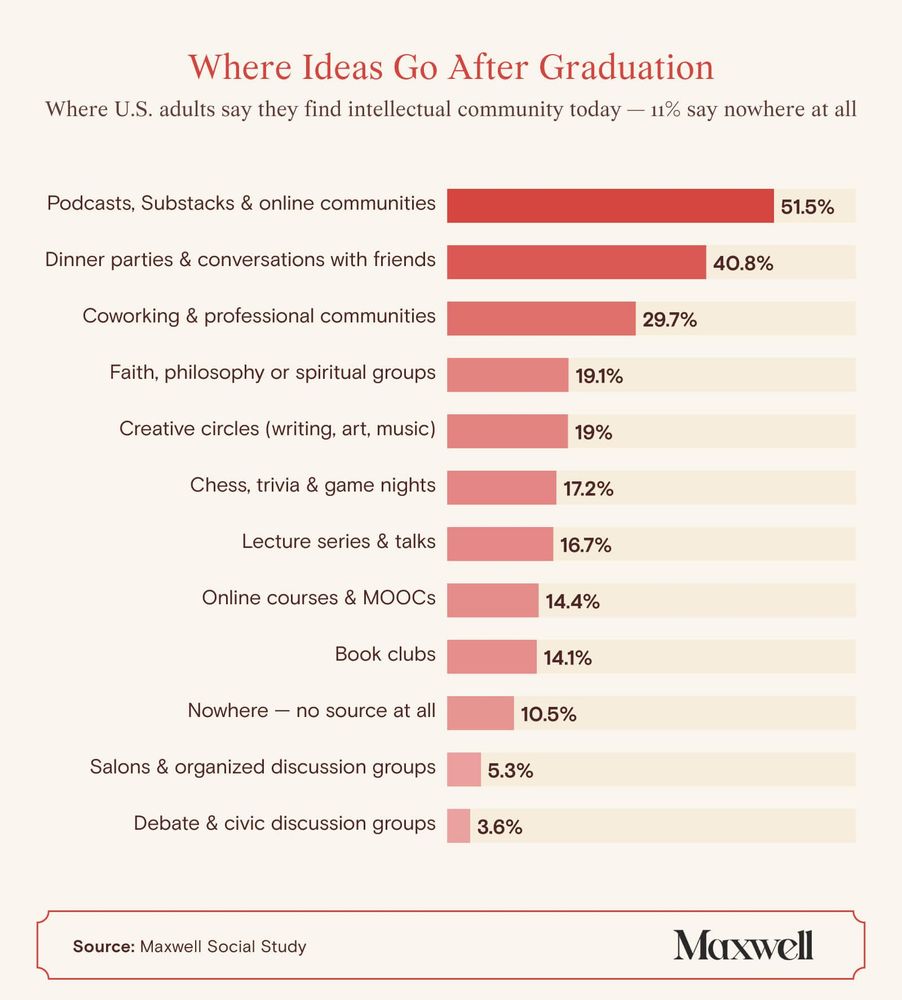
We asked 905 non-student adults where they find intellectual community after school ends, and how quickly it disappears.

Bar chart showing where U.S. adults find intellectual community, led by podcasts and online communities, conversations with friends, and professional communities.

Meaningful conversation didn't take long to fade. Adults said intellectually stimulating discussion dried up a median of just three years after they left school, and 1 in 3 haven't had a deep conversation with someone new in over a year, or can't remember the last one.

Millennials led the loneliness gap. Nearly half (49%) said they feel intellectually lonely, compared with 41% of Gen Z, 40% of Gen X, and 37% of boomers and older. Across all adults:

  • 61% said stimulating conversation is harder to find now than it was in school.
  • 53% believe making intellectually curious friends as an adult is harder than dating.
  • 45% reported feeling intellectually lonely.

While podcasts, newsletters, and online groups are the most common ways people stay intellectually connected today (52%), dinner parties and close conversations with friends aren't far behind at 41%. That in-person channel holds its ground even as connection shifts online. It's a sign of how much people still value the intimate, unhurried conversation a shared meal makes room for.

Unfortunately, more than 1 in 10 adults (11%) said they had nowhere to participate in an intellectual community. Adults earning under $100,000 were twice as likely as six-figure earners to say the same (11% vs. 5.5%). Time and nerve, not interest, were the biggest obstacles. Social anxiety and the difficulty of showing up alone kept 45% of adults from seeking out smarter social settings, and lack of time held back 41%.

The appetite for idea-driven nights didn't vary by geography: 66% of urban, 65% of suburban, and 66% of rural adults said they'd trade a night of drinking for one built around ideas. The supply wasn't as even. Over half of urban adults (53%) said their area had plenty of places to engage with ideas, compared with 39% of suburban and 28% of rural adults.

Rural adults were also more than three times as likely as urban adults to say idea-driven spaces simply didn't exist where they lived (33% vs. 9%). They were also more likely than urban adults to report feeling intellectually lonely (48% vs. 40%).

MOST ADULTS WOULD TRADE A NIGHT OF DRINKING FOR A NIGHT OF IDEAS

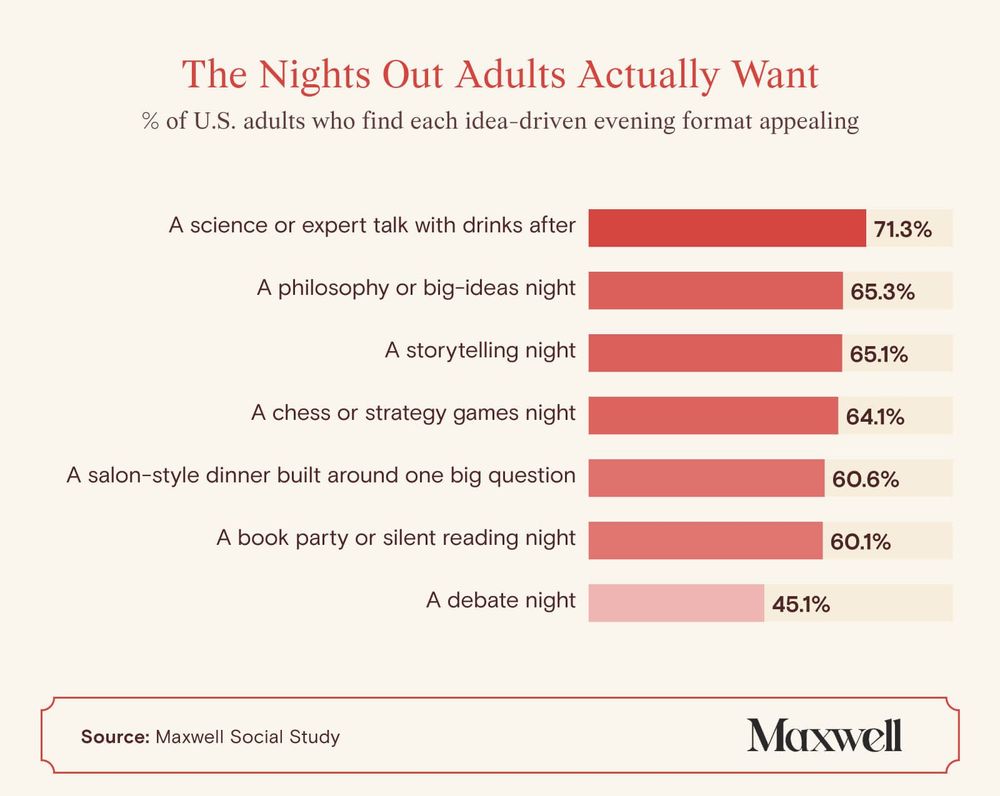
Adults have a clear appetite for nights out built around ideas, not just alcohol.

Bar chart showing the idea-driven social events U.S. adults find most appealing, including expert talks, philosophy nights, storytelling, strategy games, and salon-style dinners.

Nearly 7 in 10 adults (68%) said they crave smarter social environments as they get older, but their usual venues aren't keeping pace. Among adults who go to bars, a large majority (83%) said those spaces feel intellectually empty at least sometimes. Alcohol is losing its centrality, too: about half (49%) said it plays no role in their social life.

That preference for something more substantial becomes concrete when people are offered an alternative. About 2 in 3 adults (66%) said they'd trade a night of drinking for one built around ideas, and openness climbed to 94% once "maybe, depending on the event" was included. The five most appealing formats:

  • A science or expert talk with drinks after (71%)
  • A philosophy or big-ideas night (65%)
  • A storytelling night (65%)
  • A chess or strategy games night (64%)
  • A salon-style dinner built around one big question (61%)

Those nights remain more aspiration than routine. Just 23% said a typical night out already revolves around conversation and ideas, while 38% wished it did and 35% wished it involved learning something new. The same pull toward substance over the usual scene held among singles. A lecture, book event, or class was the top choice for meeting a partner (26%), followed by dating apps (10%) and a dinner party or salon (8%). Only 3% preferred to meet someone in a bar.

That interest carries a willingness to pay, too. Overall, 61% of adults said they'd consider paying for a membership to a social club built around ideas and conversation, including 8% who said yes outright and 53% who said it would depend on price.

THE APPETITE FOR SMARTER NIGHTS IS THERE, BUT THE ROOMS AREN'T

America's intellectual life runs through some unexpected places, and the survey shows the gap isn't in appetite. Most adults, regardless of where they live, said they'd trade a night of drinking for one built around ideas, but far fewer said their area actually has anywhere to do that. The demand for smarter, more substantive nights out already exists nationwide. What's missing in some places is the room to have them.

Methodology

To determine America's most intellectual cities, we ranked the 50 most populous U.S. metropolitan statistical areas (Census American Community Survey 2024 1-year estimates, table B01003). The San Juan, PR, metro was excluded because several federal datasets used in the study do not cover Puerto Rico; the Hartford, CT, metro was included in its place. Each metro was scored on seven weighted measures:

  • Museums, historical sites, and similar institutions per 100,000 residents (Census County Business Patterns 2023, NAICS 712; weight 17.6)
  • A public library composite of outlets, visits, and programs per capita, equally weighted (IMLS Public Libraries Survey FY2024; weight 17.6)
  • The share of adults 25+ holding a graduate or professional degree (ACS 2024, table S1501; weight 17.6)
  • Active, degree-granting, Title IV colleges and universities per 100,000 residents (IPEDS 2023; weight 11.8)
  • Adult-education schools per 100,000 residents (CBP 2023, NAICS 6116; weight 11.8)
  • Bookstores per 100,000 residents (CBP 2023, NAICS 451211; weight 11.8)
  • Search interest in intellectual activities, measured as average monthly Google search volume from August 2025 through July 2026 across 16 keywords (including "book club," "philosophy lecture," "chess club," "trivia night," and "author talk") for each metro's principal city, divided by principal-city population (weight 11.8)

Within each measure, metros were scaled so the highest-performing metro received the measure's full weight, and scaled scores were summed to a 0 to 100 Intellectual Life Score. Rankings describe the highest-ranked metros among the 50 studied, not all U.S. cities.

Event-density measures were evaluated and excluded from the index. Both Meetup and Eventbrite cap and pad their public search results, and Eventbrite has discontinued its public event-search API, so reliable per-metro event counts are not possible. One search-volume value ("philosophy lecture" in Birmingham, AL) returned no data and was treated as zero. CBP counts private-sector employer establishments only; public libraries are therefore measured via IMLS. The index captures institutional and online-search signals of intellectual life and may not reflect informal scenes; IMLS missing values were treated as zero.

For the survey, we surveyed 1,016 U.S. adults in August 2026 via SurveyMonkey about how they connect socially and intellectually after their school years. After excluding full-time students and responses that failed quality checks (attention check, response-quality flags, and age validation), the final sample comprised 905 non-student adults aged 22 and older. Respondents were asked about their school years generally rather than about a specific level of education, since 11% of the final sample never attended college. The highest level of education completed was a bachelor's degree (39%), some college (20%), a graduate or professional degree (18%), an associate degree (11%), and high school or less (11%). The gender breakdown was women (53%), men (45%), and 2% who self-described or preferred not to say. The generational breakdown: millennials (50%), Gen X (23%), Gen Z (16%), and baby boomers or older (10%). Survey figures are self-reported, and the timing of the drop-off in post-school conversation reflects respondents' own recall. Methodology percentages that do not total 100% are due to rounding.

ABOUT MAXWELL SOCIAL

Maxwell Social is a members' club and event venue in a historic Tribeca brownstone, built around dinner parties, conversation, and rooms organized around ideas rather than transactions. Members join in curated cohorts and bond over three months of shared dinners, coworking sessions, and events before becoming part of the wider community. For adults looking for the kind of intellectual community this study found missing, Maxwell Social's membership program offers exactly that room to build it.

FAIR USE STATEMENT

The findings in this study are available for noncommercial reuse. When referencing this data, please attribute Maxwell Social and link back to the original article on maxwellsocial.com.

Need help producing your event?

We built Maxwell Studios to provide full service, vertically integrated creative production, built from inside the very walls where our community has been coming alive since 2021.

CREATIVE DIRECTION

CHEF COLLABORATION

AV PRODUCTION

LOGISTICS

Address: 135 Watts, Floor 1, New York, NY, 10013

Walkable TO Westside Highway, One World Trade Center 9/11 Memorial, Duane Park, Battery Park

Nearby Neighborhoods

Tribeca, Financial District, SoHo, West Village, Greenwich Village, Nolita, Hudson Square

HOTELS NEARBY

Foquets, Greenwich Hotel, Arlo Soho, The Roxy, Soho Grand, The Frederick Hotel, Warren St Hotel, The Dominick, Hotel Hugo

LATE NIGHT spots nearby

Paul's Casablanca, Paul's Baby Grand, EAR Inn

Dinner spots nearby

The Odeon, Locanda Verde, Forgione, l'abeille, Wolfgang's Steakhouse, Yves, Mr Chows

Subway lines

Ready to join the family? We can’t wait to host you.

Ready to join the family? We can’t wait to host you.

Join our events list to get first access to availability, ideas from past celebrations, and exclusive Maxwell-hosted experiences.