The Rise of the Wedding Elopement Era

For a long time, the default wedding in America looked the same: 200 guests and a banquet hall with a head table and a cake the couple cut while the band played. In 2026, that's no longer the top choice. Maxwell Social surveyed 1,006 Americans about how they think about getting married now. Some couples are downsizing on purpose, swapping the full reception for an intimate ceremony and a party. Others are eloping first and deciding later whether to mention it.

Key Takeaways

Nearly half of Americans (49%) have considered eloping without telling anyone. About 1 in 10 people (9%) have done so, including 16% of recent newlyweds.

More than half of Americans (56%) say their ideal wedding centers on a party rather than a traditional reception, whether that's an intimate ceremony followed by a big party (30%), an elopement plus a party later (15%), or just a party with no formal ceremony at all (11%)..

About 4 in 5 Americans would trade a traditional wedding for a major financial or lifestyle milestone, including a house down payment (81%), debt payoff (81%), or a dream honeymoon or year of travel (80%).

Nearly 7 in 10 Americans (69%) say a destination elopement is the bigger flex in 2026 than a 200-person traditional reception (31%), a more than 2-to-1 majority view of what a status wedding looks like now.
The Wedding Most People Want Is Smaller

The traditional ceremony and reception is no longer the wedding most Americans want, and the people closest to the planning are moving fastest.

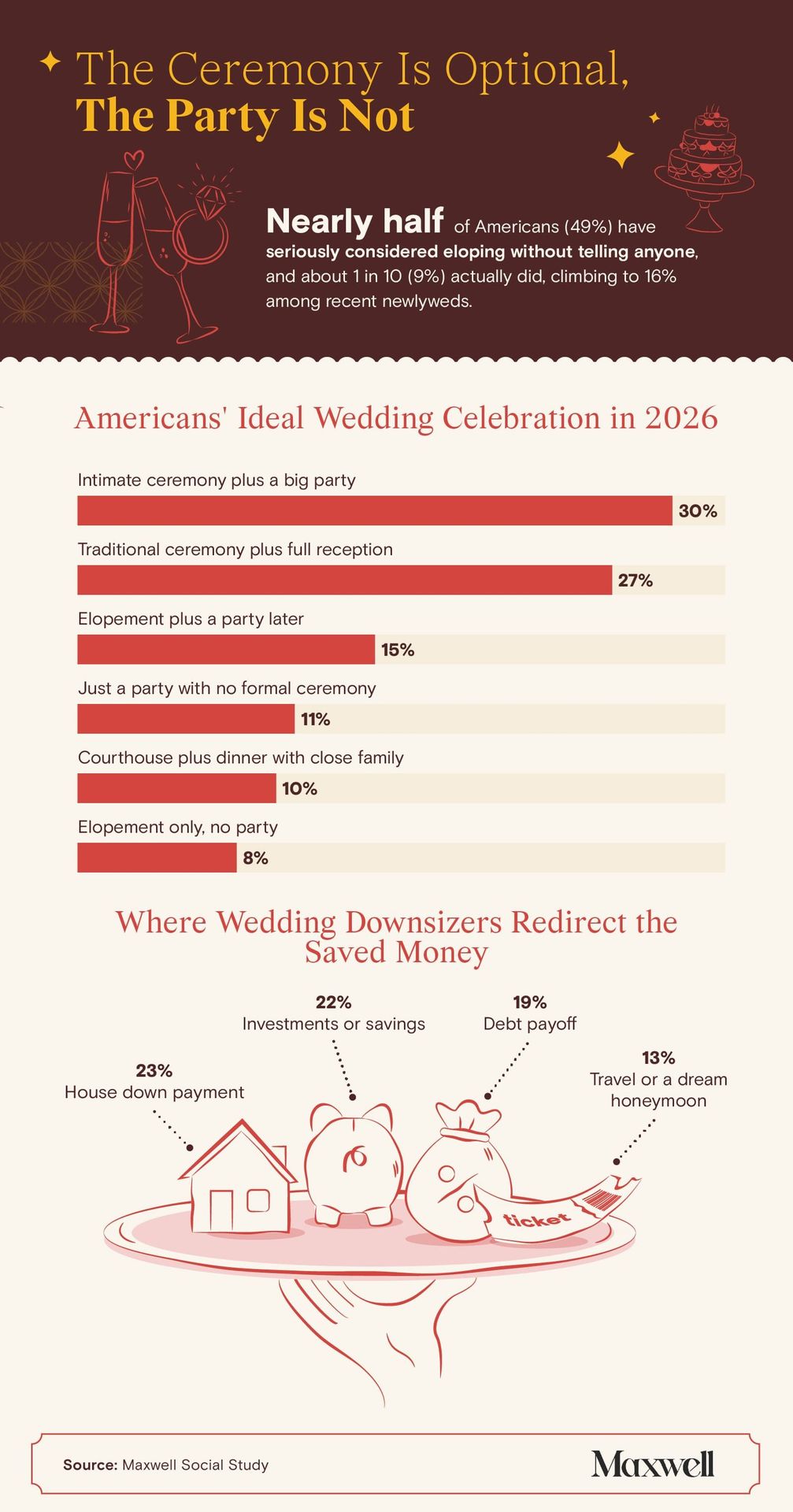
Infographic showing 49% of Americans considered secret elopements, with intimate ceremony plus big party being the most preferred wedding format at 30%.

When asked what an ideal wedding looks like in 2026, the largest share of Americans (30%) chose an intimate ceremony followed by a big party. The classic ceremony and reception came in second at 27%. Another 15% said their ideal wedding skips the ceremony altogether: elope first, throw a party later.

The shift was sharpest among the people doing the planning right now. Nearly 2 in 3 of those actively planning a wedding (64%) said they have considered eloping without telling anyone. The fantasy wasn't theoretical, either. Among Americans married within the past two years, 16% pulled off a secret elopement.

The pattern held across every generation. The intimate ceremony plus a big party was the top ideal wedding format for Gen Z (34%), Gen X (30%), Millennials (29%), and Boomers (23%), beating the traditional ceremony and reception in every cohort. The gap was widest among Gen X, where the intimate-party format edged out a traditional reception by nine points (30% versus 21%). The old default has become one option among many, and no generation calls it their top one.

What happened to the money couples saved by going smaller varied. Millennial wedding downsizers directed the biggest share to a house down payment (28%), more than twice the rate among Gen Z downsizers (13%). Couples who took the elopement route entirely spread their saved money across debt payoff (25%), investments (24%), a house (20%), and travel or a honeymoon (17%).

There's a time argument running underneath the money one. From Maxwell Social's conversations with engaged couples, a traditional six-hour wedding leaves the couple with roughly thirty minutes of real time with their friends, the rest absorbed by formalities, photos, table visits, and the receiving-line logistics of a 200-person guest list. The intimate-ceremony-plus-party format flips the ratio: a short, meaningful ceremony followed by five or six hours of actual celebration with the people who showed up.

What Couples Would Buy Instead of the Big Day

Wedding costs can quickly add up, and not everyone thinks the expense is worth it.

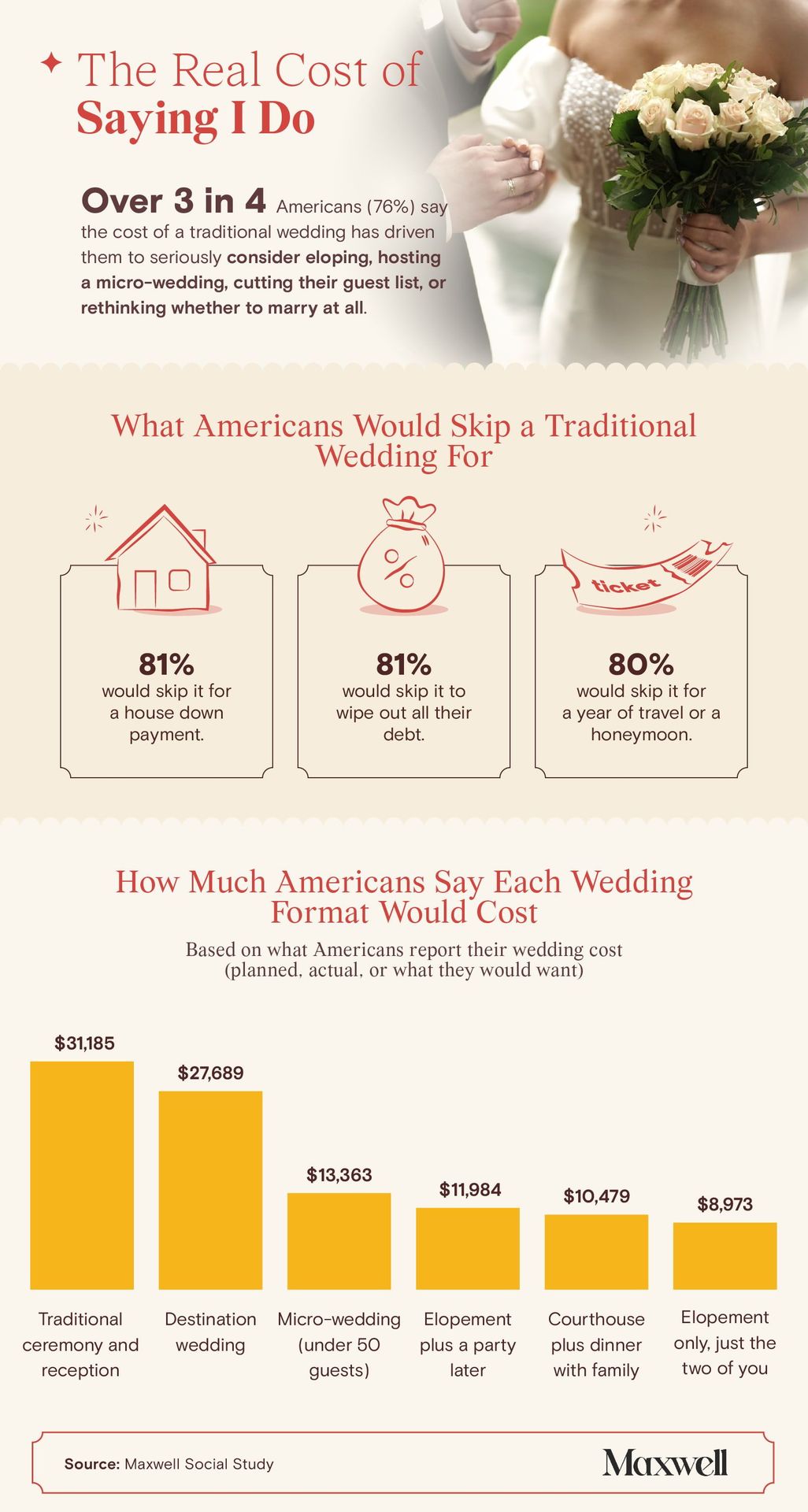
Infographic showing 76% of Americans considered alternatives to traditional weddings, with estimated costs ranging from $8,973 for elopement to $31,185 for a full reception.

A traditional ceremony and reception costs Americans about 3.5 times more on average than an elopement only ($31,185 versus $8,973), a roughly 000 gap that for many couples could cover a down payment, wipe out debt, or fund a year of travel. When asked what they would happily trade a traditional wedding for, Americans answered overwhelmingly in favor of:

  • A house down payment (81%)
  • Wiping out debt (81%)
  • A year of travel or a dream honeymoon (80%)

Among Americans earning $150K or more, more than 2 in 3 (69%) said they would still skip a traditional wedding for a house down payment. Among Americans earning under $50K, the figure climbed to 87%, with 85% also willing to skip the wedding to wipe out debt. Higher and lower earners reached the same conclusion: the wedding budget has better uses.

The financial pressure has even started to push couples out of the institution itself. More than 1 in 10 Americans (13%) said the cost of a traditional wedding has made them seriously consider not getting married at all. Another 43% have considered a micro-wedding because of cost, and women were notably more likely than men (39% vs. 29%) to say wedding costs have made them seriously consider eloping.

Family Pressure, Quiet Plans, and the New Status Flex

Behind every wedding number is the dynamic of who's paying, who's deciding, and who's being kept in the loop.

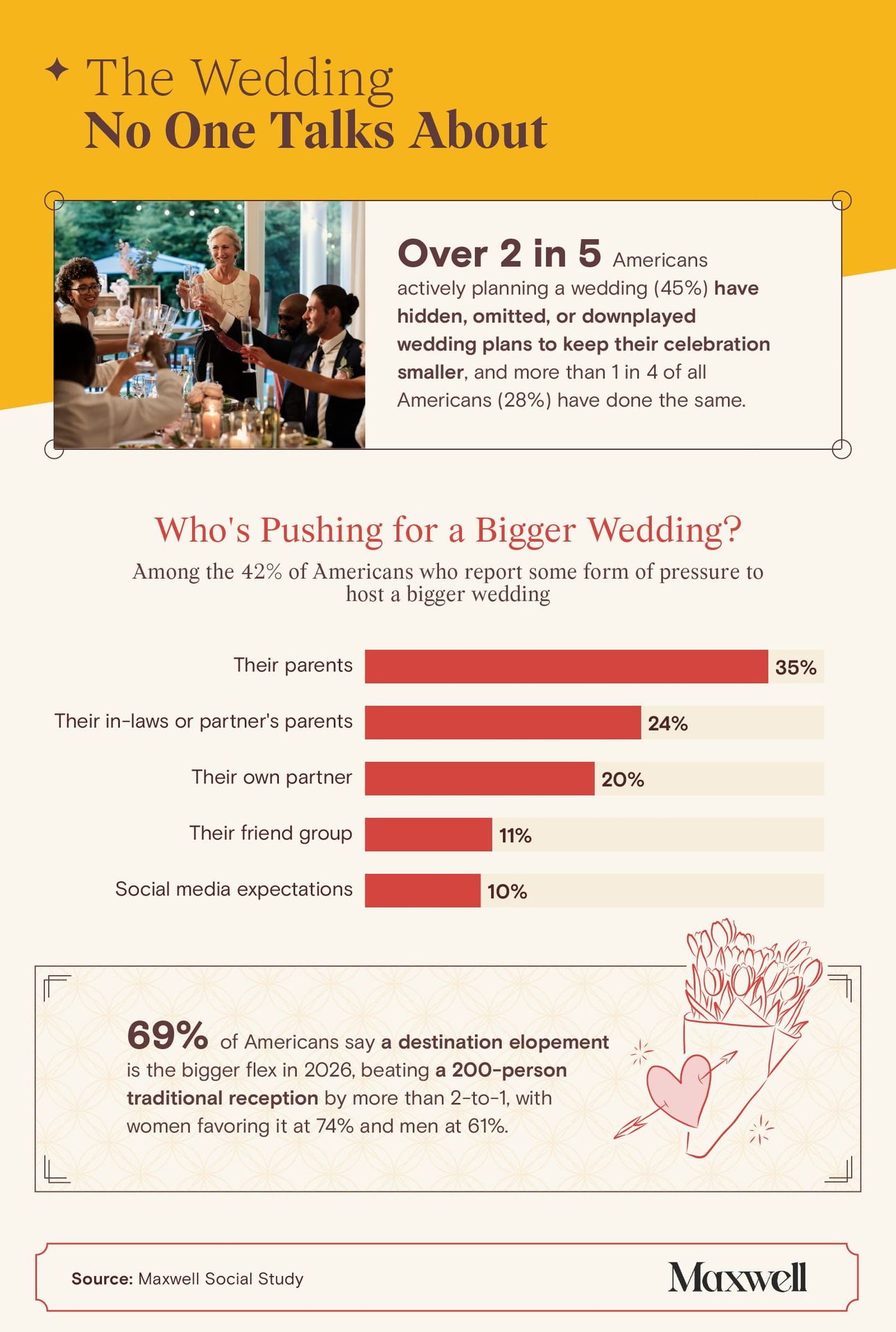
Infographic showing 45% of engaged Americans have hidden wedding plans, with parents being the top source of pressure for bigger celebrations.

When one side of the family contributed financially, 35% of Americans hid wedding plans from someone, compared with 28% when both families contributed. Couples whose wedding is paid for by one side of the family are also more than twice as likely to be hosting a wedding larger than they actually want, compared with couples paying for it themselves (26% vs. 12%).

The pressure to host a big wedding isn't a fringe complaint. Among Americans actively planning a wedding, 60% reported some form of pressure to host a larger wedding than they actually want. For a lot of couples, the wedding they're hosting and the one they would have chosen aren't the same.

When asked which wedding format said more about a couple in 2026, a destination elopement or a 200-person traditional reception, nearly 7 in 10 Americans (69%) picked the elopement. Oust 31% chose the traditional reception. The pattern held among the generations actually planning weddings. The destination elopement beat the 200-person traditional reception by more than 2 to 1 among both Millennials (68% versus 32%) and Gen Z (70% versus 30%).

The new status wedding isn't a bigger guest list. It's a smaller one with a better view, and a couple who gets to call all the shots.

The pressure isn't only financial. From Maxwell Social's conversations with engaged couples, many are now trying to combine multiple cultures, sometimes two opposed religious traditions, into a single ceremony and reception. The mini-ceremony-plus-party format may be gaining ground in part because it sidesteps the question entirely: a smaller, more flexible ceremony carries fewer expectations to honor, and the party that follows carries none of them.

What a Wedding Looks Like Now

The wedding couples want in 2026 is more intentional, personal, and often a lot smaller. And the celebration doesn't have to end at a courthouse. Whether it's an intimate dinner party for newlyweds who just signed the papers or a local celebration for a couple who tied the knot abroad, the after-party is where the story gets told.

Maxwell Social is a New York wedding venue built for exactly that. It's a private and beautifully appointed space where the people who matter most to you can gather to celebrate. The guest list may be shorter, but the celebration can still be fantastic.

Methodology

We surveyed 1,006 Americans about how they view, plan, and prioritize modern wedding celebrations, with a focus on the rise of elopements, micro-weddings, and intimate alternatives to the traditional ceremony and reception. The sample included Gen Z (25%), millennials (53%), Gen X (18%), and baby boomers (5%). Methodology percentages not totaling 100% are due to rounding.

About Maxwell Social

Maxwell Social is a private members club and event venue in a historic Tribeca brownstone in New York City, designed to feel like a second home rather than a status club. The space hosts intimate ceremonies, after-parties for courthouse elopements, and chef's table dinners, the kinds of small, meaningful celebrations more couples now say they want. Host your next celebration at Maxwell.

Fair Use Statement

These findings are free to share for noncommercial purposes. If you reference the study, please link back to Maxwell Social so readers can access the full results and methodology.

Need help producing your event?

We built Maxwell Studios to provide full service, vertically integrated creative production, built from inside the very walls where our community has been coming alive since 2021.

CREATIVE DIRECTION

CHEF COLLABORATION

AV PRODUCTION

LOGISTICS

Address: 135 Watts, Floor 1, New York, NY, 10013

Walkable TO Westside Highway, One World Trade Center 9/11 Memorial, Duane Park, Battery Park

Nearby Neighborhoods

Tribeca, Financial District, SoHo, West Village, Greenwich Village, Nolita, Hudson Square

HOTELS NEARBY

Foquets, Greenwich Hotel, Arlo Soho, The Roxy, Soho Grand, The Frederick Hotel, Warren St Hotel, The Dominick, Hotel Hugo

LATE NIGHT spots nearby

Paul's Casablanca, Paul's Baby Grand, EAR Inn

Dinner spots nearby

The Odeon, Locanda Verde, Forgione, l'abeille, Wolfgang's Steakhouse, Yves, Mr Chows

Subway lines

Ready to join the family? We can’t wait to host you.

Ready to join the family? We can’t wait to host you.

Join our events list to get first access to availability, ideas from past celebrations, and exclusive Maxwell-hosted experiences.