

Picture a house in Big Sur. A secluded lodge or mansion surrounded by ancient trees and overlooking the water and cliffs. Plenty of room for a dozen or so people to gather. This is the kind of scene the actor Jimmi Simpson describes when he brings up the ayahuasca ceremonies he attends about once a year. The host, he suggests, might be someone who made a fortune in tech, but then discovered the money didn’t answer the questions that drove them to earn it.
“Oftentimes, it’ll be at the home of someone who happens to have a lot of means,” he says. In his telling, people have an experience that changes their lives, then want to offer others the same possibility: “I hope I can help others.”
Guests arrive with journals and very specific intent: there’s something they hope to unlock, to uncover, to understand. There are mats and pillows and blankets and puke buckets. A shaman leads the ceremony. Not the kind of off-kilter guru you might imagine in one of Simpson’s films or shows—someone serious, deep and kind.
Simpson is generally the only actor to attend, but picture the particular expressiveness of his face in this setting, and one could imagine the opening to a murder mystery. He just has a gift for making you wonder what he’s up to. Here, though, he shares his straightforward intention: Pushing through serious discomfort in order to reach something real.
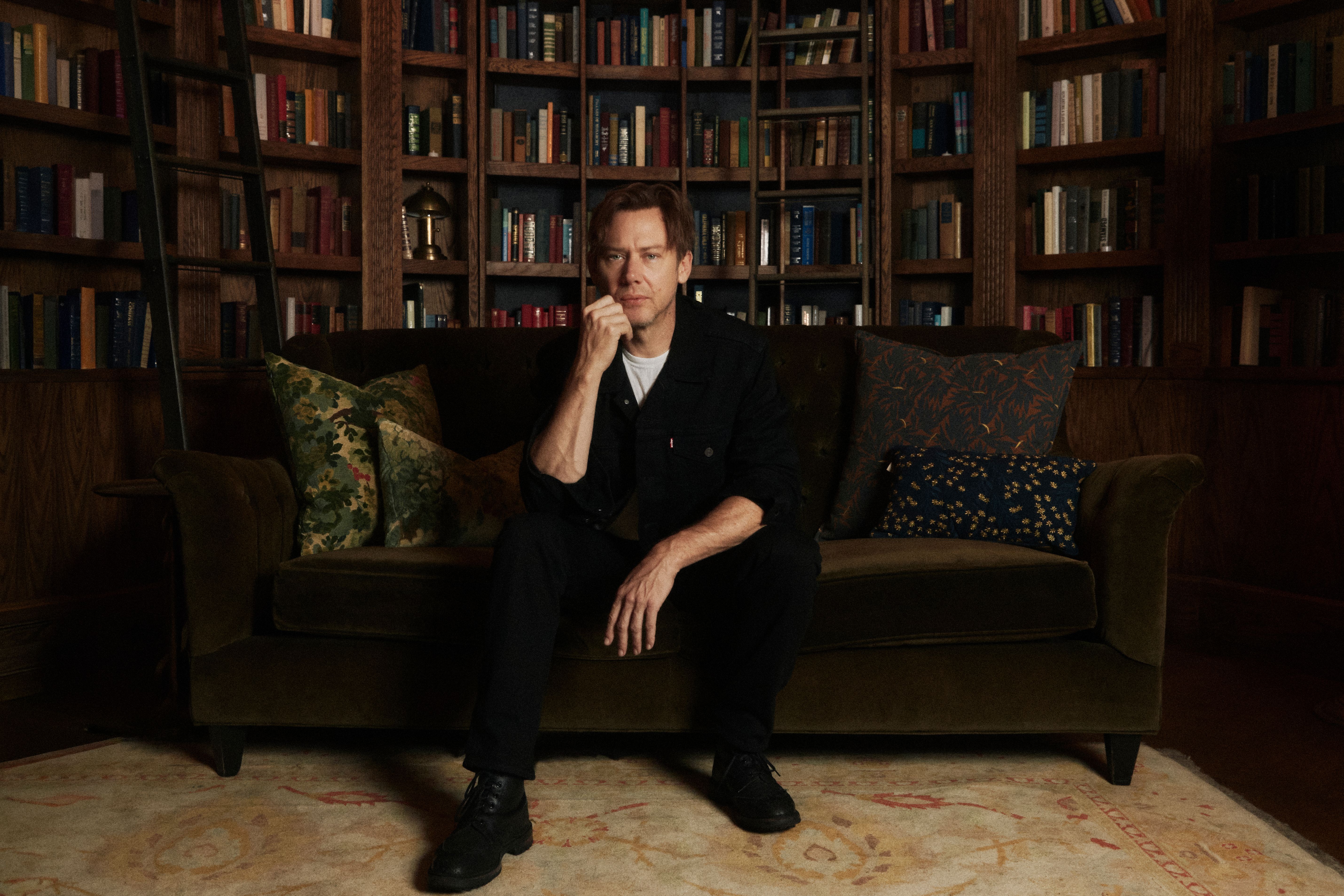
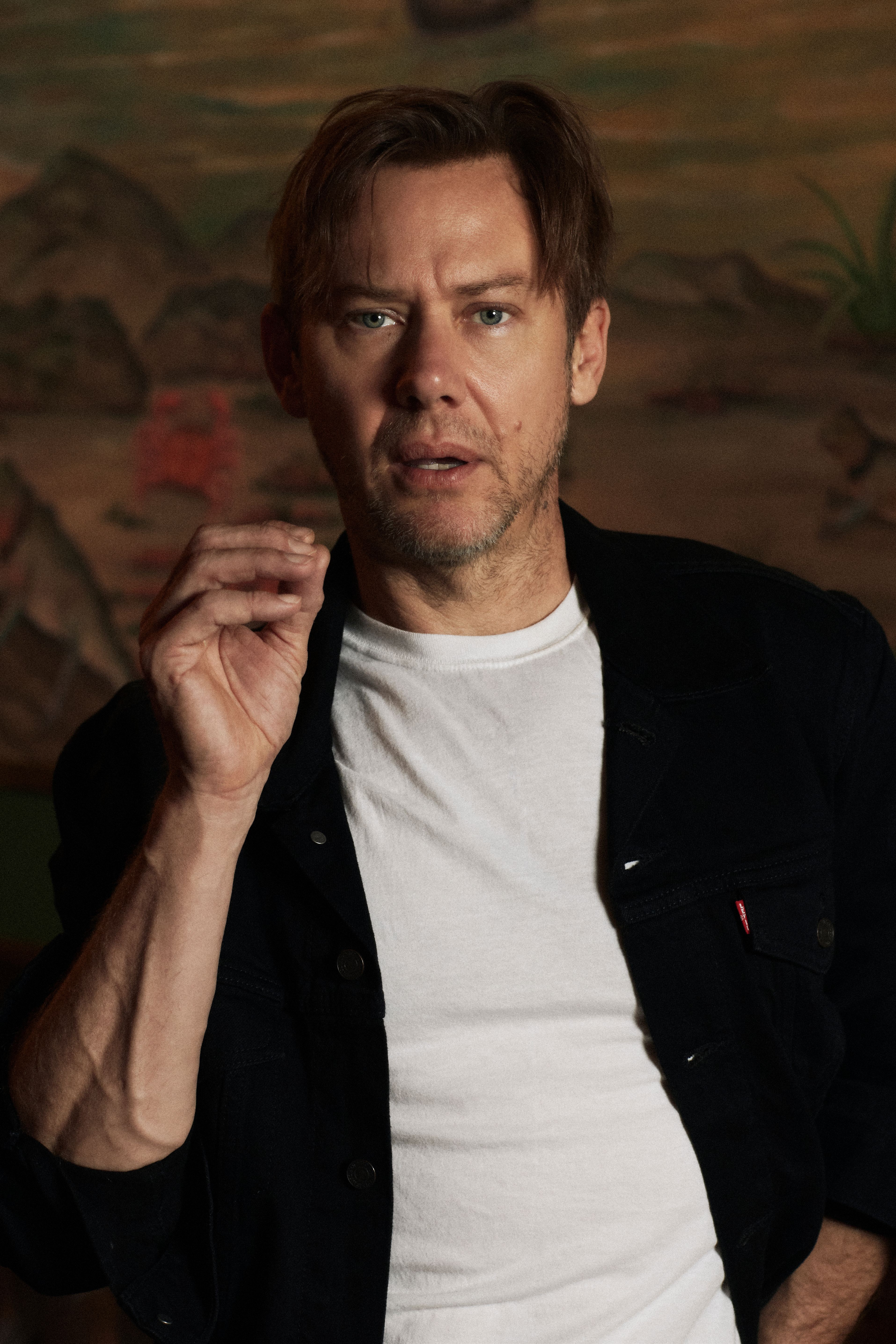
For many of us, his face first registered two decades ago as the milk-mustachioed Liam McPoyle on It’s Always Sunny in Philadelphia. Since then, Simpson has moved between that character’s wild absurdity and the dramatic worlds of House of Cards, Westworld, and Black Mirror. More recently there’s been Dark Matter and The Walking Dead: Dead City. And his slate includes the forthcoming Hulu legal drama Conviction, which stars Elisabeth Moss.
So from the grotesque slapstick of McPoyle to prestige TV leading man, how did he get there?
Before acting, you were thinking about becoming an English professor. How did you imagine your life might look?
I come from small-town Jersey. Cows and sod and corn. I had zero exposure to making a living from the arts. I’d never met an artist who made a living, so it wasn’t an option. I really loved musicals, and I loved singing. But again, there was no part of me that was like, “I’m going to be a Broadway singer.” I didn’t think my voice was quite that, but I loved the storytelling of musicals. And my favorite thing in the world was reading books. I was obsessed with reading. It was taking me to other worlds every single day. I was the kid with the sheets over my head and the flashlight.
It started with The Little Prince and Shel Silverstein's Where the Sidewalk Ends. As I started growing up, I found so much joy in Stephen King and his tangential storytelling. In fifth grade I read Moby-Dick and was just like, “This is the greatest thing that I’ve ever seen.”
Not a lot of fifth graders read Moby-Dick.
I wasn’t aware of that.
Was it the pleasure of reading you wanted to share as a teacher, or were you already interested in how stories were put together?
I was fascinated with showing people that storytelling, that writing a book, is a creative puzzle process. When I started reading, I was like, “How do they do this?” Then I started realizing, well, the foreshadowing probably comes well after the story is created; there’s this way that you can build this thing out. I thought that was such a gorgeous concept to let people know, and to demystify and de-terrify the idea of writing a book.
But it wasn’t like, “Oh, I have to do that.” It was, “I would like to do that.” I had a business minor because I was like, “Well, maybe I have to get an office job.” Everything in my life has been like, “I think I’d like to try that.” I haven’t really been driven by, “I have to do that or I die.”
So how do we get to acting?
The second half of my sophomore year of college I had a free elective, so I took a theater course. Well, I didn’t go to the class. So in order not to fail, I had to perform something. I picked a spoken dramatic scene from Assassins. It’s John Wilkes Booth convincing Lee Harvey Oswald to take the shot. After that, my professor said, “Hey, you should add this to your major.” I just said, “Sure, why not?”
From there, the first play I auditioned for was A Midsummer Night’s Dream, and I got Puck. It was set in the sixties, and I could make Puck what I wanted to make him.
When I graduated, I sold my motorcycle, went to Williamstown, built sets, and got to see what people do to survive as theater actors.
There were no Hollywood dreams. I’d love to tell stories onstage; I’d also like to pay rent and eat. It was about learning the craft, and also learning how you file for unemployment. Things come and go. That was all part of it.
I told myself, “I’m gonna try this, and if I’m unhappy for three years, I’m gonna do something else.” There was a plan to attempt this version of storytelling, but there was no, “I gotta shine,” or, “I gotta find that spotlight.” It was living in a way that I enjoyed. If I wasn’t going to enjoy it, I would find another way to live.
What did being an apprentice at Williamstown actually involve? I’m picturing grown-up theater camp?
No, no. I had to pay to work for them, and that was my pleasure because I had never had that exposure. I built sets. I was on the crew for The Glass Menagerie, with Eric Stoltz and Dana Ivey. You get this exposure to people like that. You live in a dorm, meet a community of like-minded and like-aged humans, and you share.
Not a lot of fifth graders read Moby-Dick.
I wasn't aware of that.
One of the benefits Williamstown offered was that they attracted people who really knew what they were doing. And they would teach these little 90-minute master classes.
That was literally my entry point into Hollywood. I took the stand-up master class Lewis Black was offering. He was just like, “Tell a funny story that happened to you.” After the class was over, we decided we would go to the cafeteria at eleven p.m., when nobody needed it, turn on one of the lights, and do our seven-minute routines for each other. Somebody told Lewis. When his main stage play was over, he came to check out these kids. It just so happened his agent was there to see him do the play, so she tagged along.
They entered right as I was doing my stand-up bit about accidentally taking two hits of acid at fifteen and the ride it took me on. A week later, he tells me, “My agent wants to sign you. You should call her.” Then I was auditioning for TV shows in New York.
You also met Charlie Day and some of your eventual Sunny collaborators there. What was it about those friendships that stayed with you?
Charlie and I, everything clicked. We went from Williamstown and moved in together in New York City. I told my agent about him, and she signed him right away.
Neither of us was getting work. But we found this comic footing together shooting these ridiculous videos together. We just watched them with each other or invited David Hornsby or a couple of friends over. Nate Mooney, who plays my brother on It’s Always Sunny, was also at Williamstown. That’s how that relationship started.
I wonder whether, if that happened now, you two would just become TikTok creators?
Absolutely. Charlie and I could go to Kim’s Video, get DVDs, see Cool Hand Luke and Sling Blade. We were after this rich storytelling of filmmaking. YouTube didn’t quite exist. Certainly Instagram and TikTok and short form didn’t exist.
Westworld was a huge jump. Your role on It’s Always Sunny was purely comedic. You played that hacker on House of Cards. Then suddenly you’re leading an HBO series. A big one. Was that terrifying?
Not at first. I had no idea about the arc. This is how not keyed in with the industry I was, and probably always will be—I got Westworld, and I didn’t really know what the show was. I loved the Michael Crichton movie, and part of me thought there was a little spoof quality to this, a gentle send-up.
My first scene wasn’t until episode two, so I got to see the pilot before I started filming. They bring me to the ranch. And I watched this thing with my jaw on the floor. I mean, the scope of the performances, Anthony Hopkins, Evan Rachel Wood, Ed Harris. Honestly, my first thought was, “Why am I here?”
I realized I needed to be part of this huge story engine. I took a new approach to what I’d been reading. It was the first chance I had to be an essential part of the narrative, where if I failed, things would fall apart. I hadn’t had that responsibility before. I didn’t go to acting school. Westworld was my place to learn.
"I don’t separate comedy and drama. That’s not my job. My job is to play the truth, and the audience is gonna decide if something’s funny. Liam McPoyle has no idea he’s in a comedy. Ryan from Dark Matter has no idea he’s in a sci-fi show."
It’s sort of incredible that you’ve so successfully grown your acting craft in that way. And yet you still show up on It’s Always Sunny going full absurdism.
I don’t separate comedy and drama. That’s not my job. My job is to play the truth, and the audience is gonna decide if something’s funny. Liam McPoyle has no idea he’s in a comedy. Ryan from Dark Matter has no idea he’s in a sci-fi show. It’s about playing the reasonable truth for the character, despite the unreasonable circumstances.
You’ve mentioned Black Mirror creator Charlie Brooker and Dark Matter author Blake Crouch as examples of what you call “predictive sci-fi.” Those are worlds where the unreasonable circumstances are everything.
Whereas The Twilight Zone was calling on our fears throughout history—human fears of invasion or isolation—Brooker’s going, “What’s happening next?” Blake Crouch in Dark Matter does that beautifully, while also playing on this age-old human fear: What if I’d gone left instead of right? What if I’d said yes instead of no?
I love folks with a strong internal logic that’s maybe not shared by the rest of civilization. I don’t think of these characters as weird. I love playing completely reasonable sequences of events that everyone else sees as unreasonable. They’re reasonable to them.
I was told you want to talk about ayahuasca? Lay it on me.
The funny thing is, that accidental double dosing of LSD at fifteen—the bit that caught Lewis Black's attention—was a very expansive experience. It opened my eyes to things we don’t quite pay attention to, even if it’s just the geometric perfection of leaves above you.
It was never about, “Whoa, party!” I never raved. When I hopped into the real world in my twenties, I was like, “Well, I should probably leave that behind.”
When ayahuasca was presented to me, part of me was like, “Is that just another version of this psychotropic?” And while it may have psychotropic properties, it’s deeply internal. The simplest way I could describe it is that it helps me recognize my authentic self beneath a lot of inherited noise, including Hollywood’s enormous collection of do’s and don’ts. Not because I’ve transcended any of it. I can still be vain, frightened, and ambitious with the best of them. I’m just a little better at noticing when I am performing a version of myself that’s maybe not true.
When you sit for a ceremony, what are you hoping to get from it? Is this about your work, or more about your own happiness?
The way I have ceremonies, it’s with a group of people over three days. What you’re doing is saying, “I’m gonna go through something uncomfortable because I’d like to get in touch with what’s real for myself.”
What I love is I’m generally the only actor there. When I began, I didn’t know a single person. Now, when I return, I’ll generally know about half of the, let’s say, twelve people.
"I love folks with a strong internal logic that’s maybe not shared by the rest of civilization."
Everyone’s got an intention. You have a journal, and you’re like, “This is what I’m hoping to uncover, unlock, see more of.” We get selfish and fearful. Let’s say you’re in a relationship that’s stagnant. You don’t know why; you just know you don’t really feel it anymore. It might show you, “You’ve been holding back from this person who’s been giving you, and you didn’t even understand it. See what they’re doing, see how they’re treating you, and feel it.” Or it might say, “You’ve been feeling stagnant because you’re not seen. You’re not happy here.”
This world is a freeway of distractions. This life is not scrolling. I don’t mean to sound cliché, like, “Don’t scroll.” It’s part of this life. Sure, there’s entertainment there. But losing yourself to the distractions—that’s what I think plant medicine, both ayahuasca and psilocybin, are glorious medicines to heal.
Real quick, can we go back to your casting in House of Cards? I remember seeing your hacker character appear on screen, and thinking: isn’t that the weird guy with milk on his lip from It’s Always Sunny? How on earth did you make that jump?
Well, I had just broken up with my wife. It was maybe two months after we’d broken up. I was this young, early-middle-aged, recently divorced shell. I didn’t have any real clothes. I didn’t really know what was happening. I rolled into this audition and did what I could with what I had.
Afterward, the casting director—who knew me a little—she said, “How are you doing?” She’d heard about the breakup. I told her I was getting through it. She said, “I really love you both, and I’m thinking about you.” I said, “That’s really kind,” and I left.
The audition wasn’t good enough. She reached out to my manager—this has never happened to me before or after—and said, “I think Jimmi could do better. Let’s bring him back in two days.”
It was that little spark of humanity in this ocean of industry. It empowered me with a little more clarity and confidence. "Sure, I didn’t do well, but she thinks I could do better."
So I got that part on House of Cards, which certainly began my dramatic career, because of the humanity of a casting director.