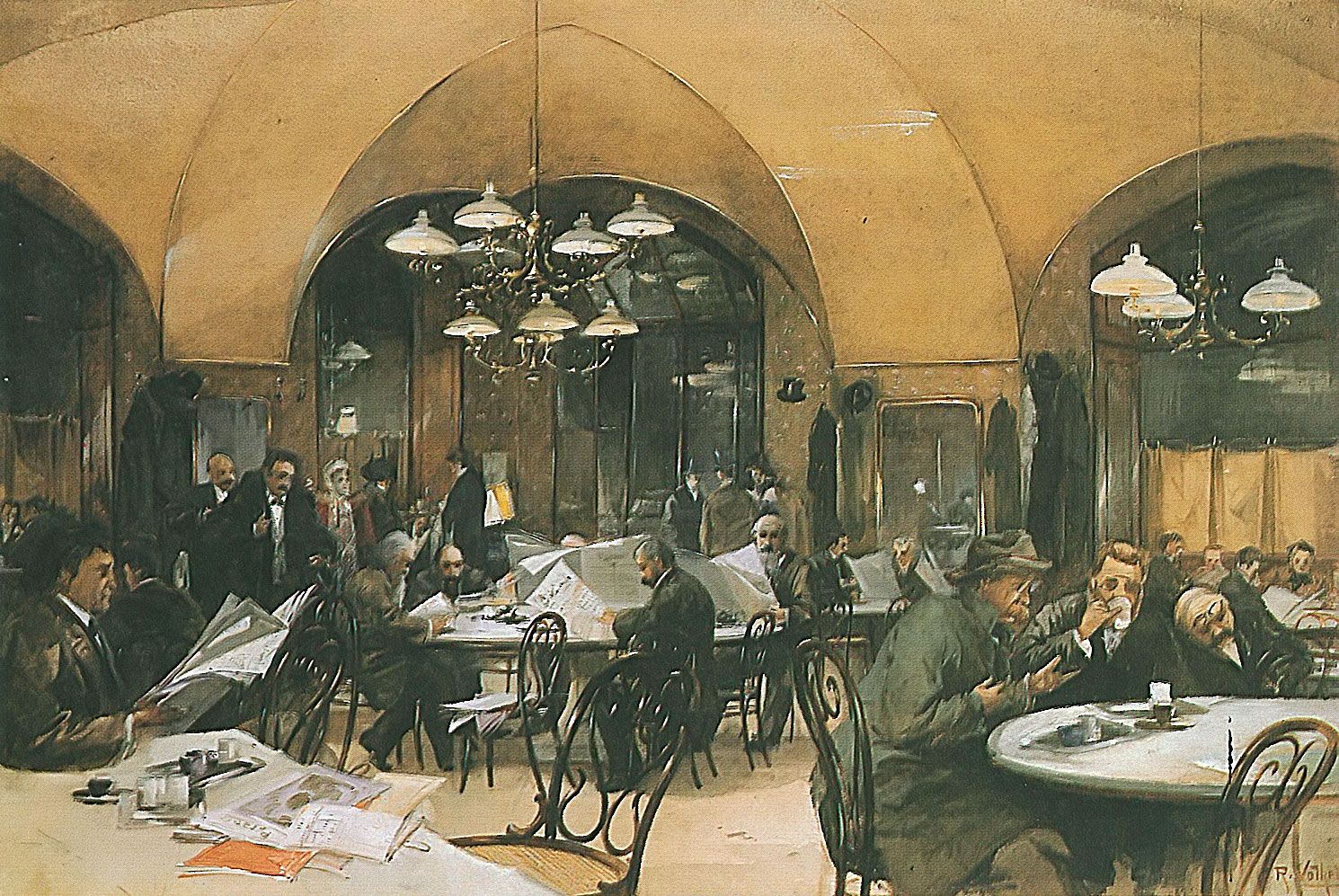

On a blustery Vienna night in December 1896, Felix Salten walks into Café Griensteidl. The novelist sees his friend Karl Kraus sitting across the room, walks over, and slaps the man twice across the face. The entire café falls silent. Then, one imagines, someone orders another coffee.
Kraus, the Nobel-nominated satirical essayist, was then a sharp-faced, twenty-two-year-old who had spent the better part of the year publicly excoriating everyone in the room. And what a room. Hugo von Hofmannsthal, Arthur Schnitzler, Hermann Bahr, and Peter Altenberg—the glittering constellation of fin de siècle literary figures known as Jung Wien. All were now nursing their coffees and wounds. But it was Salten who'd gotten it the worst; Kraus had mocked his prose style, his syntax, and for good measure, exposed his secret affair with actress Ottilie Metzl.
Arthur Schnitzler recorded the episode for posterity, writing in his diary: "Salten slapped little Kraus in the coffeehouse. Universally well received."
Karl Kraus spent the next four decades raking intellectuals over the coals. He went on to torment Salten hundreds of times in his magazine Die Fackel. Never favorably. Meanwhile, Salten’s most famous novel is known to every child on earth through its cervine protagonist, Bambi. Though he reportedly only made about $1,000 from its sale.
The Griensteidl itself closed the following year, its literary quarrels dismantled with its mirrors and marble—but none of it was forgotten. Kraus ended his satirical essay The Demolished Literature with the question: “Where is our young literature headed now? And which is its future Griensteidl?”