
It’s a December morning in Miami, and Zoe Buckman is taking me on a brief tour of her temporary kingdom: a hotel room somewhere above the chaos of Art Basel. Moments earlier we'd been discussing Brooklyn brownstones—ours are in the same neighborhood—and she compliments her Zoom view of mine, though I know for a fact hers is prettier.
“I fucking love our neighborhood,” she replies.
She’s in Miami for the opening of her show Who By Fire at the Mindy Solomon gallery, and to give a talk with José Carlos Diaz, chief curator of the Pérez Art Museum Miami.
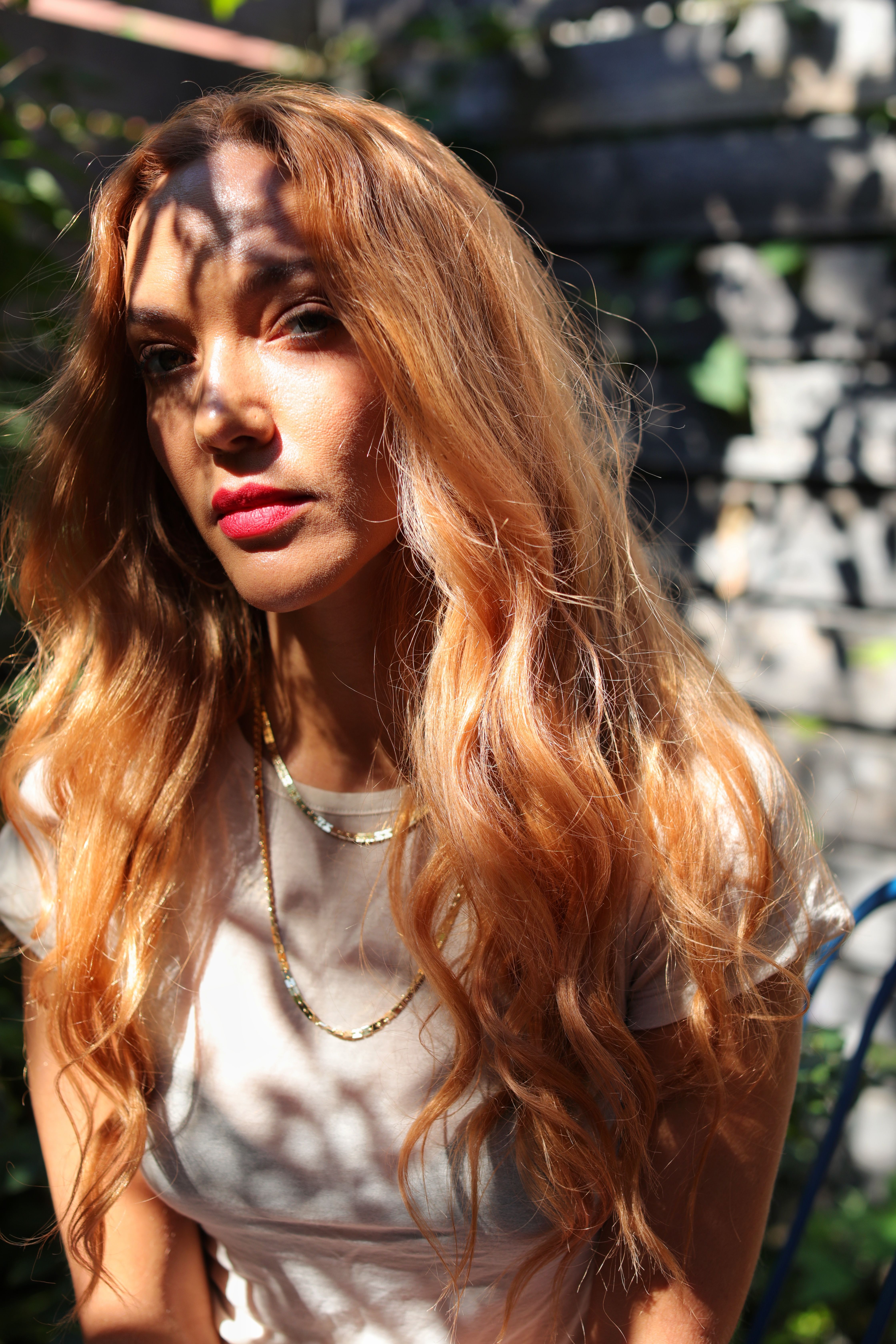
Everywhere Buckman goes, she carries a small film camera, collecting images of friends and family as a kind of diary. Those photographs eventually become the basis for her embroidered pieces—labor-intensive works that blur the boundary between painting, textile, and portraiture.
“The decisions with the embroidery are very in the moment,” she explains. “I’ll start embroidering the eye and suddenly think, oh, this person doesn’t have orange eyes—I’ve never met anyone with orange eyes—but I want this iris to be orange. And maybe I’m going to add bright green on the cheek.
“From afar it looks quite realistic, but when you come close you see all these decisions I’m making in real time. Threads hanging down, drips almost like paint. I see the threads as this kind of mark of the work and the artist—I was here. This is toil. This is labor. "Because the hard work of what it is to be in these bodies and in these identities is a big part of what I’m trying to say with the work. There’s always a little discomfort in it. It’s never meant to be perfect.”
The result is both painterly and tactile. From across the room the portraits appear almost academic—figures rendered with softness and emotional clarity. But as you approach, the rendering breaks into thread and knots and color.
For Buckman to have arrived at portraiture at all is something of a surprise—even to her. For years her practice incorporated embroidery and domestic textiles but avoided figurative imagery. Depicting women felt fraught. The art-historical tradition of the female figure, she felt, was contaminated by the male gaze.
Then the pandemic arrived. “During lockdown I really felt like there wasn’t going to be an art world anymore,” she says. “The world as we knew it was over. And weirdly that was liberating. Before that I was very aware of what was expected of me as an artist—that I wasn’t a painter, that I didn’t do figurative work. I avoided it because I’m sick of the objectification, of seeing women sprawled across canvases.
“But during the pandemic I was so lonely. My family was in London. I didn’t know when I would see them again. I had just lost my mom. Half the time I had my six-year-old with me and half the time I had absolutely no one in my life. I needed people in my life to feel alive. So I started painting them.”
Gradually those figures became more confident, more central, more present. Friends appear dancing, sitting at dinner tables, or captured in quiet domestic moments. Over time the portraits expanded in scale as well, moving from tentative sketches toward larger compositions stitched across entire tablecloths.
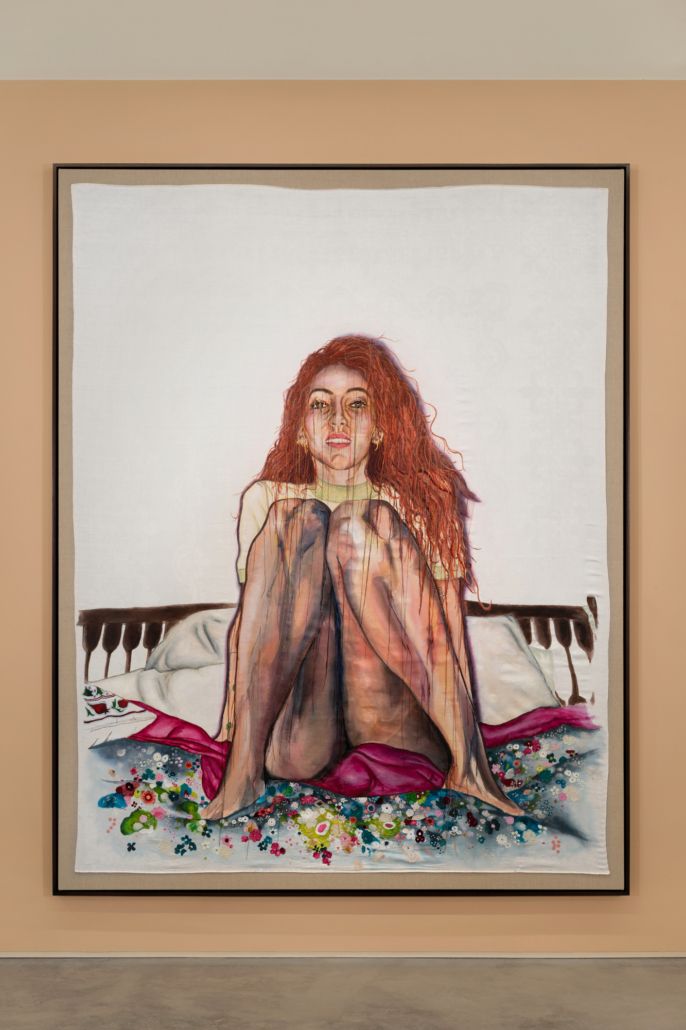
In September 2023, her show Tended opened at Lyles and King in New York. It focused on the bonds between women in her life, how they supported and cared for each other, on intimacy, community, and the ways identity shapes relationships.
But for Buckman, who is Jewish, the meaning of community changed dramatically after the Hamas attacks of October 7.
“That show was about the women in my life, my community,” she says. “And after October 7 some of the people in those portraits cut me out of their lives completely. That was an awakening of sorts. Oh, this is what it is to be Jewish. This is what my grandparents experienced. Something happens, there’s a shift, and suddenly we’re villainized again, even by friends of ten or twenty years."
“What shocked me most was that there was no conversation. The people who rejected me socially, who even tried to have me canceled in the industry, they never came to talk to me. There was no attempt to sit down and figure out our differences.”
Unlike many artists in the contemporary art world, Buckman chose not to stay quiet about the wave of antisemitism she felt was spreading across cultural spaces after the attack. Through social media she became one of the few artists—particularly among left-leaning creatives—willing to speak openly about it.
And to be clear, Zoe Buckman sits firmly, vocally on left. Her words on Israel and Palestine have been careful. She’s taken pains to recognize the long suffering and plight of the Palestinian people, the respect and self-determination they deserve. But in our current environment, everything is black and white, for or against. It’s inescapable.
"I second guess it all the time,” she admits. “Every time I post about antisemitic hate in New York, I still get this nauseating feeling in my stomach. It makes me feel really exposed.” But she continues.
“If all it does is show other Jewish people that I see you, that I’m upset and scared too, then that’s enough,” she says. Despite losing gallery representation, losing friends, losing who knows what else—none of this has derailed her career. If anything, Buckman finds herself at a moment of unusual momentum.
She currently has work in several museum collections and is preparing for a solo show at the Pérez Art Museum Miami, opening in October this year. The curators she had built relationships with over the years, she says, haven’t disappeared.
“They know my practice. If they believed in the work before, they didn’t go anywhere.”
Back in the hotel room, Buckman returns to describing her practice, how the portraits evolve in the studio. Even once the painting is finished and the embroidery has begun, she says, the work can take on its own momentum.
“I’ll look at it and think, this needs some cuckoo crazy,” Buckman says, laughing. “She’s expanding. Things are flying out. She’s powerful! Or is she disappearing?”