
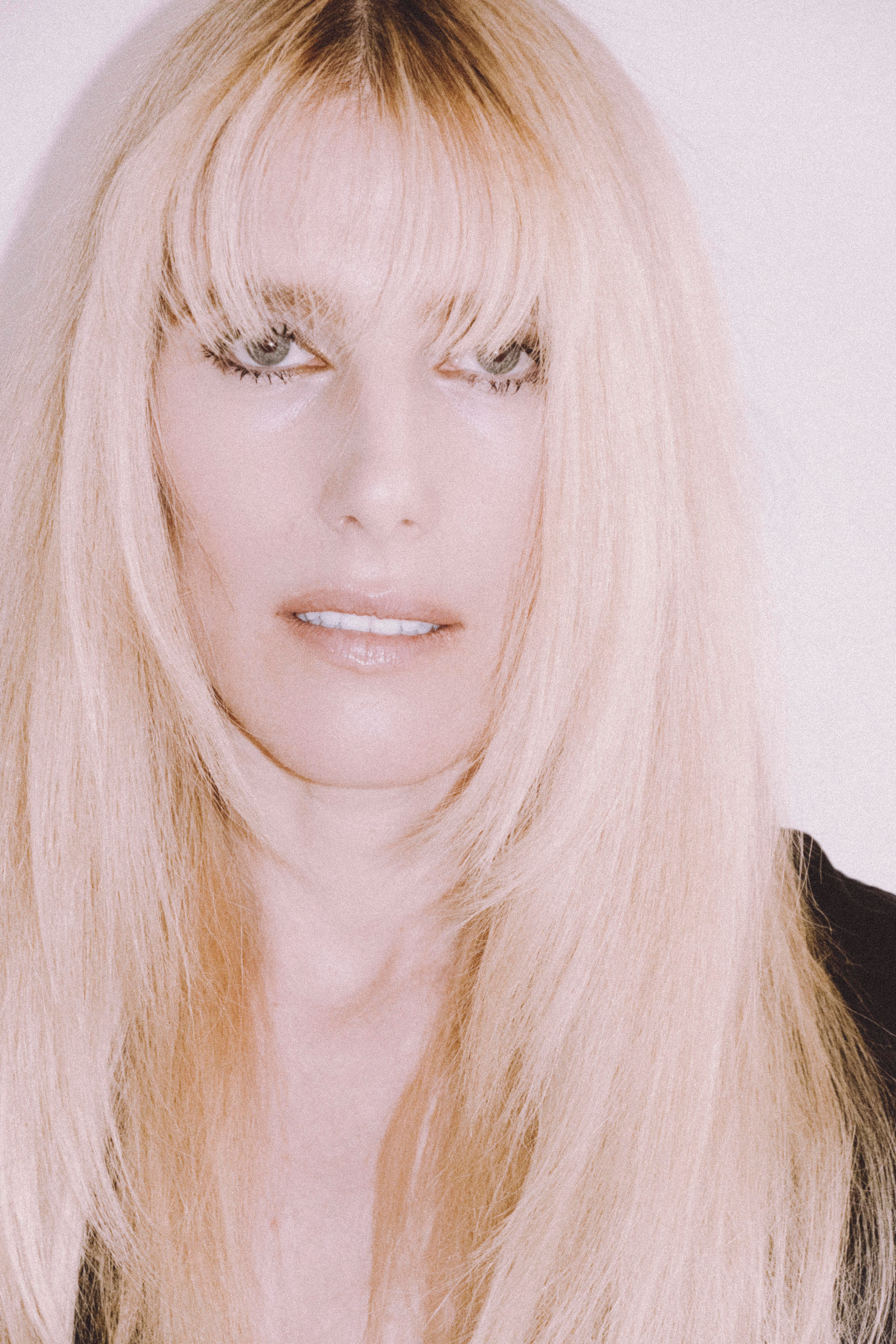
Dree Hemingway has the rare quality of seeming slightly out of time. Part of it is the name, of course, one that arrives trailing a century of literary mythology, but it’s also something in the way she moves through the culture. Hemingway has built a career that resists easy categorization: a model with a real acting résumé, an actress who slips comfortably between indie films, fashion projects, and the occasional period fantasy. In conversation she feels less like a contemporary celebrity than a figure from an earlier era of Hollywood, when careers could unfold a little more eccentrically and people were allowed to inhabit more than one lane.
That sensibility turns out to be a surprisingly good fit for
Love Story, Ryan Murphy’s lush and compulsively watchable series about the doomed romance of John F. Kennedy Jr. and Carolyn Bessette. Like many Murphy productions, the show treats history less as documentary than as atmosphere—an emotionally heightened world of beautiful clothes, famous families, and very public heartbreak.
One of the show’s more debated storylines involves Kennedy’s earlier relationship with actress Daryl Hannah, whom Hemingway plays. On screen, the character is volatile, wounded, occasionally chaotic—a sharp contrast to the golden mythology surrounding the Kennedy orbit. Some viewers have bristled at the portrayal, which Hannah herself has criticized as inaccurate.
Hemingway, however, approaches the role from a slightly different vantage. As someone who grew up inside another American cultural dynasty, one that carries its own freight of myth, expectation, and storytelling, she understands instinctively how easily real lives become narrative material.
She isn’t interested in litigating the internet’s reactions or defending the mechanics of television drama. Instead, she talks about love stories: messy ones, tragic ones, the kind where two people clearly care for each other even as the relationship quietly or not so quietly collapses.
Jacob Mendel Brown: So what first drew you to this project? The Kennedys? The Daryl aspect?
Dree Hemingway: To be honest, I was first drawn to the idea of a Carolyn Bessette and JFK Jr. story. I remember reading an article saying that Ryan had signed on to do it, and I thought, I just want to be a part of that. But I’m also a hopeless romantic. I just love love stories. No matter how they turn out — tragic, messy, all of it. I am that girl.
When I first read it, well I knew I was auditioning for Daryl, and she’s truly one of a kind. The scenes themselves were really about the end of a relationship—where you can tell these two people have so much history. There’s one person fighting more for the relationship than maybe the other person, and the other person doesn’t want to hurt them, so it becomes this push and pull.
JB: Some have reacted strongly to the show’s version of Daryl Hannah.
DH: I’ve seen people saying things like Ryan did Daryl dirty, why does he hate her so much? And I honestly think they’re missing the point that this isn’t the Daryl–JFK story.
This is also very much a dramatization of everything. We’re taking real situations of what we know, books and things like that, but everything is being dramatized in that Ryan way, which is so him and spectacular.
You’re seeing the end of a relationship. I was trying to portray her as somebody who’s like, “No, I really love you. I want to make this work.”
And when I see articles calling her annoying or this or that, I just don’t see her that way. I find her really sensitive. I find her very different from a lot of people. There’s a beautiful almost childlike aspect to her where she’s honest to a fault.
JB: Your performance often feels very human, even when the story itself is heightened.
DH: For me, acting is about being grounded and being human. There are times when we as humans are more activated, of course, but I think everybody is grounded in who they are.
If I needed to play someone who was completely over the top all the time, I could do that. But even then there’s something real underneath it.
JB: Something about your career feels slightly old Hollywood.
DH: I started wanting to be an actress because I was obsessed with Turner Classic Movies—Katharine Hepburn, Grace Kelly, all of those women.
That old-school mentality of things very much draws to do what I do. Even though we live in a world of Instagram and all of that, there’s something about that earlier era that still feels very romantic to me.
JB: Is there a push-pull between the acting and modeling?
DH: I’ve always felt like an actress, and for a long time I felt like an imposter in the modeling industry. But now I’ve come to terms with the idea that we don’t have to pick which one we are. I think we can be both. It’s all a kind of artistic adventure in different ways.
"You're seeing the end of a relationship. I was trying to portray her as somebody who's like, 'No, I really love you. I want to make this work.'"
JB: You also have a particular relationship to American mythology yourself. Did that ever cross your mind while working on a show about another famously mythologized family?
DH: It’s not something I consciously thought about while we were filming. I really try to approach things scene by scene.
But I do have a perspective on fame and family that maybe comes from that background. No matter how famous someone is, or how big their family name is, behind closed doors we’re all going through the same things. The feelings are the same.
JB: You’re also working on a film about Ernest Hemingway.
DH: Yes. It’s about the end of his life.
He was undergoing electroshock therapy, his friends thought he was going crazy, and it all takes place around the time he was living in Sun Valley, Idaho.
It’s a really intimate story, and I think a real actor’s movie. They originally approached me just to read the script, and I was so moved by it that when they asked if I would come on as an executive producer I said yes immediately.
JB: What is it like exploring that history when it’s your own family?
DH: There are things I’ve known, and then there’s also research and stories you discover along the way.
There was definitely a moment in my life when people expected me to know everything about him, and I kind of had the rebellious reaction of saying, I don’t need to know anything about him.
But as I’ve gotten older, and through traveling and working, I’ve met people who knew him or had stories about him, and that’s been really incredible.
He died three months before my mother was born, so there’s also this distance. But through his love of travel, his love of people and nature and experience, I feel very connected to him in a lot of ways.
JB: You actually wrote Daryl Hannah a letter after filming.
DH: I wrote her after I had finished filming. It wasn’t about permission. It was really just that I felt like I had spent so much time with her, in a way, that I wanted to write her a love letter.
I admired her before getting the role, but there was something about her that I really grew to love and feel protective of while doing this.
She’s one of the few living people portrayed in the show, and I just thought it was the right thing to do. There was no expectation of her writing back or getting in contact. I just wanted her to know that I care about her, and that everything I did in playing her came from a place of love.